A number of pages on the Government of Saskatchewan's website have been professionally translated in French. These translations are identified by a yellow box in the right or left rail that resembles the link below. The home page for French-language content on this site can be found at:
Where an official translation is not available, Google™ Translate can be used. Google™ Translate is a free online language translation service that can translate text and web pages into different languages. Translations are made available to increase access to Government of Saskatchewan content for populations whose first language is not English.
Software-based translations do not approach the fluency of a native speaker or possess the skill of a professional translator. The translation should not be considered exact, and may include incorrect or offensive language. The Government of Saskatchewan does not warrant the accuracy, reliability or timeliness of any information translated by this system. Some files or items cannot be translated, including graphs, photos and other file formats such as portable document formats (PDFs).
Any person or entities that rely on information obtained from the system does so at his or her own risk. Government of Saskatchewan is not responsible for any damage or issues that may possibly result from using translated website content. If you have any questions about Google™ Translate, please visit: Google™ Translate FAQs.
Soil Sampling 101: From Field to Lab – How to Soil Sample for Accurate Soil Testing
As we near the end of another growing season and head into fall, producers are making decisions that will help set their farms up for success in the coming year. One of these decisions is fall soil testing, which is crucial for determining the current soil nutrient status and for guiding future nutrient applications to meet yield goals. Soil testing is also a cornerstone of a strong 4R nutrient stewardship plan. However, the value of a soil test is only as good as the soil sample collected, hence, a reliable test begins in the field.
Given the significant variability of soil within a single field, it is essential to use proper sampling techniques to ensure the samples are as representative of the field as possible. If you are having soil sampling done by a service provider, it is always a good idea to go with the service provider when the samples are being collected. As a producer, you know your fields better than anyone else and can assist in getting the best samples and benchmark sites to represent your fields or management zones.
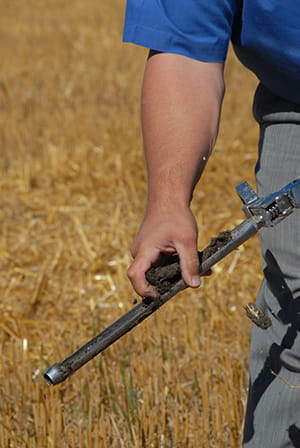
Soil testing with probe
Understanding Your Field is Key to Determining Sampling Method to Adopt
A key step in collecting a representative soil sample is understanding the characteristics of the field from which the samples will be collected. Field variability such as topography, drainage, eroded areas, soil texture (e.g., sandy vs. clay-rich zones), etc. should be considered. The choice of sampling method should reflect these features while avoiding unrepresentative areas such as salinity patches, field edges, fence rows, dead furrows, high and low spots, manure piles and other problem areas, unless you are testing these areas specifically for separate management decisions. If the locations of fertilizer bands are known, take samples at random locations between the fertilizer bands.
Common Soil Sampling Methods
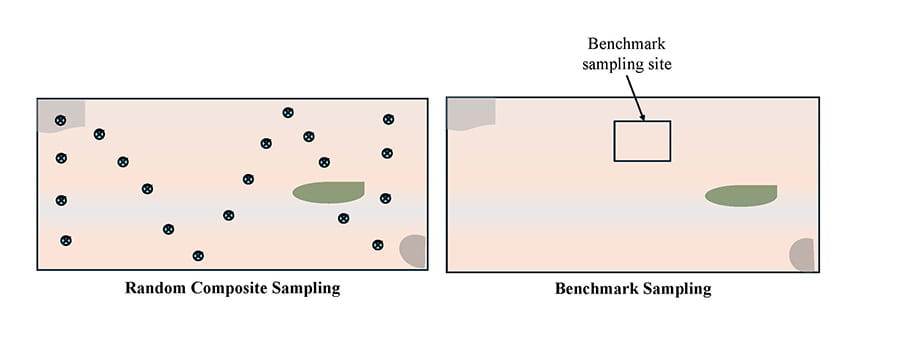
Whole field-based sampling – This involves the collection of one composite sample to represent an entire field. The two most common sampling approaches used for the whole field-based sampling method are the random composite and benchmark sampling.
Random composite sampling – This involves the collection of random samples across the field by following a zigzag or “W” pattern.
Benchmark sampling – This involves the collection of samples from a small area that is representative of the entire field. Benchmark sites should be clearly marked using GPS or another reliable method for consistency in future sampling. The whole field sampling approach is best suited for relatively uniform fields with minimal natural variation.
Illustrations of random composite and benchmark sampling methods
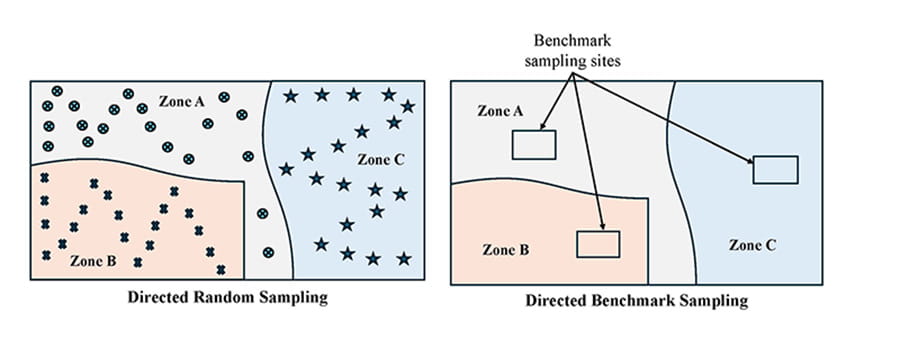
Zone-based sampling – In this sampling method, the field is divided into distinct management zones based on unique characteristics (e.g., soil type or slope), and composite samples are randomly taken within each zone. The directed random composite and the directed benchmark sampling are two of the most common approaches used under this method. This sampling method is ideal for fields where no single area accurately represents the whole field.
Illustrations of directed random and directed benchmark sampling methods
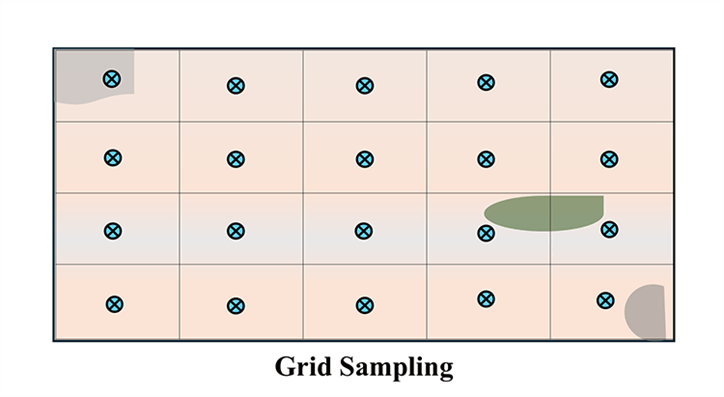
Grid sampling – This is mostly used in precision agriculture, and it is the most detailed and expensive method. In this sampling method, the field is divided into small, uniformly sized blocks (e.g., 0.5 to 5 acres), with samples collected from each block. While comprehensive, this method may not be economical for most operations.
Illustration of grid sampling method
Sampling Depth and Sampling Procedure
For no-till or minimum tillage systems and most basic tests, sampling to a depth of six inches is sufficient. However, when testing for mobile nutrients like nitrogen and sulfur, sampling down to at least 24 inches using either two depth intervals (0 to 6 inches and 6 to 24 inches) or three (0 to 6 inches, 6 to12 inches, 12 to 24 inches) is preferred and appropriate for accuracy.
Take at least 15 to 20 soil cores from across the field, mix them thoroughly to create a composite sample. Take a subsample (usually 500 grams or as specified by your lab) from the composite sample and send it for testing.
In drier years, there is a higher likelihood that fertilizer nutrients will remain concentrated in the bands where they were applied. To account for this, it is advisable to increase the number of cores to 30 or more when forming your composite sample. This helps reduce the impact of banded fertilizer on test results and ensures a more accurate representation of the field’s nutrient status.
During soil sample collection, remove the top layer of dead leaves and plant materials. Use a soil probe or auger (not a shovel if it can be avoided) to collect soil samples at specified depths into a clean labelled plastic bucket. Ensure the tools for sampling are free of rust or any debris and have not been used to collect or hold fertilizer, manure or compost. Avoid using a metal bucket as it can interfere with test results. Be sure to insert the probe vertically into the soil, not at an angle, to ensure a consistent and accurate sample depth.
Additional information on soil sampling can be found in the Soil Sampling Guidelines from the Government of Alberta or by contacting the soil testing lab you deal with.
Post-Sampling: Handling, Storing and Shipping Samples
Sampled soils must be well labelled with field ID, sampling depth, date, area description and cropping history of that field (knowing the previous crop, such as a pulse crop, can provide a nitrogen credit on the recommendation).
Since it is not practical or possible to get soil samples to the lab within 24 hours of sampling in most cases, it is important for the soil samples to be air-dried and cooled before shipping to the lab if you are doing the soil sampling yourself. If the soil sampling service is provided, the company will collect and deliver the samples at the end of the day using rapid delivery.
Immediately after sampling, soil should be stored in a cooler (can be refrigerated but not frozen). Freezing is not recommended as the freeze-thaw cycle can alter soil nitrogen forms.
Once samples are cooled, package them securely and ship promptly to the soil testing lab for analysis.
Always check with your lab for specific guidelines on sample handling and packaging requirements.
Please contact your local crops extension specialist or the Agriculture Knowledge Centre at 1-866-457-2377 for additional information.
We need your feedback to improve saskatchewan.ca. Help us improve