A number of pages on the Government of Saskatchewan's website have been professionally translated in French. These translations are identified by a yellow box in the right or left rail that resembles the link below. The home page for French-language content on this site can be found at:
Where an official translation is not available, Google™ Translate can be used. Google™ Translate is a free online language translation service that can translate text and web pages into different languages. Translations are made available to increase access to Government of Saskatchewan content for populations whose first language is not English.
Software-based translations do not approach the fluency of a native speaker or possess the skill of a professional translator. The translation should not be considered exact, and may include incorrect or offensive language. The Government of Saskatchewan does not warrant the accuracy, reliability or timeliness of any information translated by this system. Some files or items cannot be translated, including graphs, photos and other file formats such as portable document formats (PDFs).
Any person or entities that rely on information obtained from the system does so at his or her own risk. Government of Saskatchewan is not responsible for any damage or issues that may possibly result from using translated website content. If you have any questions about Google™ Translate, please visit: Google™ Translate FAQs.
Sending in Weed Seeds for Herbicide Resistance Testing
When weeds become unmanageable, they can impact crop production by competing for resources, causing dockage in harvested grain and serving as hosts for diseases and problematic pests.
Identifying herbicide-resistant weeds is important for determining the most cost-effective way to reduce their impact on crops. The best way to tell if a weed is resistant to a particular herbicide is to submit a sample of the weed seeds for testing.
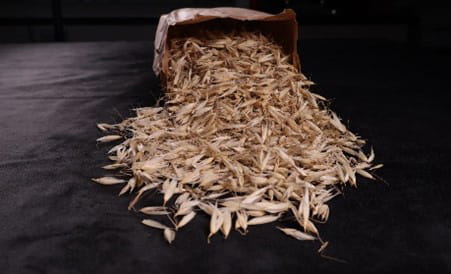
A sample of wild oats submitted for herbicide resistance testing.
Weed seeds need to be collected at maturity before a desiccant is applied to the crop. For most species, hand collection is the best method. However, for some wind-dispersed seeds, a sweep net or small vacuum may be best for collecting seeds. The Crop Protection Lab needs 2,000 seeds per herbicide group tested. However, for some populations this number is not realistic, so it is asked that as many seeds be collected as possible.
Seeds must be submitted completely dry, which can be accomplished by allowing them to air dry on a piece of paper for a few weeks. This ensures proper evaluation at the lab. Samples can either be dropped off in person at 1610 Park Street, Regina or sent by mail. When mailing, place the weed seeds in a dry paper bag and remember to include a completed herbicide resistance form. All herbicide resistance tests must be submitted to the laboratory by January 15.
Informed management decisions can lead to the most cost-effective solutions to crop production problems. The impact of weeds can be significant; however, if controlled appropriately, the impact can be minimized.
Please contact your local crops extension specialist or the Agriculture Knowledge Centre at 1-866-457-2377 with additional questions related to herbicide resistance testing.
We need your feedback to improve saskatchewan.ca. Help us improve