A number of pages on the Government of Saskatchewan's website have been professionally translated in French. These translations are identified by a yellow box in the right or left rail that resembles the link below. The home page for French-language content on this site can be found at:
Where an official translation is not available, Google™ Translate can be used. Google™ Translate is a free online language translation service that can translate text and web pages into different languages. Translations are made available to increase access to Government of Saskatchewan content for populations whose first language is not English.
Software-based translations do not approach the fluency of a native speaker or possess the skill of a professional translator. The translation should not be considered exact, and may include incorrect or offensive language. The Government of Saskatchewan does not warrant the accuracy, reliability or timeliness of any information translated by this system. Some files or items cannot be translated, including graphs, photos and other file formats such as portable document formats (PDFs).
Any person or entities that rely on information obtained from the system does so at his or her own risk. Government of Saskatchewan is not responsible for any damage or issues that may possibly result from using translated website content. If you have any questions about Google™ Translate, please visit: Google™ Translate FAQs.
Winter Cereals are Gaining Ground in Saskatchewan
By Margaret Parsons, AAg, Agri-Environmental Specialist, Humboldt
September 2025
In Saskatchewan, winter cereals are typically seeded in late August or early September. These fall-planted crops can include fall rye, winter wheat or winter triticale. Winter cereals can serve as dual-purpose crops, used for grain, forage and grazing. These crops can provide several agronomic and environmental benefits. Fall seeded crops are advantageous for spreading out workload, as timing for seeding, spraying and harvesting will differ from spring crops.
Winter cereals offer protection from soil erosion in the winter and spring. This is especially beneficial for light soils as planted crops in the field over winter offer stabilization below ground as the roots hold onto the soil and vegetative cover above ground slows the flow of water across the soil. Winter cereals also feed the soil microbiome and absorb nutrients that could be lost from the soil over the winter. The timing of plant growth for winter cereals coincides with moisture availability in late fall and early spring, which leads to better water use efficiency than spring cereals.
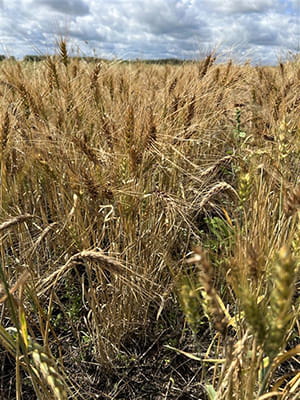
A field of winter wheat
Winter cereals are more competitive against weeds than spring cereals, which can reduce the spread of weed seeds, as well as potentially reduce associated herbicide costs. Early spring weeds, such as wild oats, can be outcompeted by the already established winter cereals. This is a benefit to conventional producers, but also to organic producers.
Winter cereals offer forage potential for livestock. In drought stress years where late summer grazing capacity is needed, winter cereals are more suited than spring cereals or other annual forage crops.
A two-year Agriculture Demonstration of Practices and Technologies (ADOPT) project from April 2024 to February 2026 showcases winter cereals in Prince Albert at the Conservation Learning Centre. Winter wheat, winter triticale and fall rye were seeded at optimal and delayed seeding dates. The project’s aim is to compare winter survivability and yield potential between species and between different cultivars. This demonstration site is helping to promote more widespread adoption of winter cereals in Saskatchewan and how they perform in different regions of the province. With the availability of more hardy winter varieties in recent years and changing environmental conditions, winter cereals have become a more attractive option to producers. More years of dry conditions in certain regions of Saskatchewan highlight the need to take advantage of late fall and early spring moisture, a role winter cereals are well adapted for.
For more information on winter cereals, reach out to your local specialist or call the Agriculture Knowledge Centre at 1-866-457-2377.
We need your feedback to improve saskatchewan.ca. Help us improve