A number of pages on the Government of Saskatchewan's website have been professionally translated in French. These translations are identified by a yellow box in the right or left rail that resembles the link below. The home page for French-language content on this site can be found at:
Where an official translation is not available, Google™ Translate can be used. Google™ Translate is a free online language translation service that can translate text and web pages into different languages. Translations are made available to increase access to Government of Saskatchewan content for populations whose first language is not English.
Software-based translations do not approach the fluency of a native speaker or possess the skill of a professional translator. The translation should not be considered exact, and may include incorrect or offensive language. The Government of Saskatchewan does not warrant the accuracy, reliability or timeliness of any information translated by this system. Some files or items cannot be translated, including graphs, photos and other file formats such as portable document formats (PDFs).
Any person or entities that rely on information obtained from the system does so at his or her own risk. Government of Saskatchewan is not responsible for any damage or issues that may possibly result from using translated website content. If you have any questions about Google™ Translate, please visit: Google™ Translate FAQs.
Managing Herbicide Resistance through Herbicide Layering
By Davidson Ugheoke, AAg, Crops Extension Specialist, Moose Jaw
November 2025
Herbicide resistance has become a major challenge for farmers in Saskatchewan. Weeds such as kochia, wild oats, green foxtail and wild mustard are developing resistance to multiple herbicide groups, reducing the effectiveness of products that once worked well. This situation threatens crop yields, increases input costs and impacts farm sustainability. To combat this, farmers need integrated weed management strategies, with herbicide layering being one of the most practical and effective approaches.
What is Herbicide Layering?
Herbicide layering involves using multiple herbicides with different modes of action within a single growing season to control the same weed populations. Unlike simply rotating herbicides year to year, layering stacks different modes of action within one crop cycle making it harder for weeds to survive.
For example, a wheat grower might apply a pre-seed herbicide from Group 6, 27 combined with a Group 9, followed by an in-crop application of a mix of Group 2 and 4 herbicides and finish with a post-harvest burndown if needed. Each application targets weeds at different stages with different chemicals to provide overlapping control.
Why Layering Matters in Saskatchewan
Saskatchewan’s dryland farming systems, characterized by short growing seasons and diverse crop rotations, present unique weed management challenges. Heavy reliance on single modes of action, such as Group 1 for wild oats or Group 9 (glyphosate) for pre-seed burndown and in-crop weed control, has led to widespread resistance across the prairies.
Recent surveys show that over 60 per cent of Saskatchewan fields now have wild oats resistant to Group 1 or 2 and glyphosate resistant kochia has spread throughout much of the southern grain belt. Often resistance limits available cost-effective herbicide options.
Layering isn’t about eliminating weeds in one season but about preserving the effectiveness of current tools over the long term. In areas where glyphosate-resistant kochia is common, farmers using layering techniques can keep weed populations manageable while maintaining crop yields.
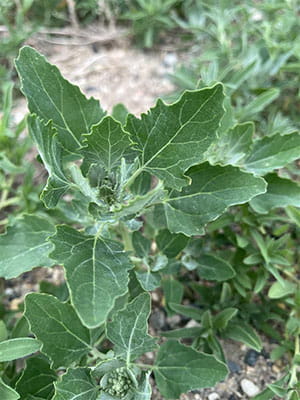
Lamb's quarters plant
Practical Approaches to Layering
Pre-seed Residual Herbicides
Farmers often start with glyphosate for pre-seed burndown. Adding a residual herbicide from group 14 (flumioxazin, saflufenacil, carfentrazone) or Group 15 (pyroxasulfone) helps control early weed flushes like kochia, cleavers and volunteer canola. The grower’s crop rotation plan determines pre-seed herbicide options.
In-crop Herbicide Layering
Layering continues with in-crop applications. A canola grower might use glyphosate in Round-Up Ready systems but also apply residual herbicides from Group 15 before seeding or in fall to control grassy weeds. In cereals, combining Group 1 or 2 products with broadleaf active ingredients from Groups 4, 6 or 27 offers broader weed control.
Post-harvest Applications
After harvest is usually a good time to control weeds like winter annuals or perennials. Applying Group 4 herbicides (such as 2,4-D or Dicamba) with glyphosate in fall helps prevent weeds from setting seed, reducing the seed bank for the next season.
Integrating Layering with Other Practices
While herbicide layering is effective, it works best when combined with non-chemical strategies such as crop rotation and seeding rates. For example, alternating cereals, pulses and oilseeds makes weed adaptation more difficult (i.e. planting lentils allows the use of different chemicals than wheat or canola). Similarly, higher seeding rates of barley or oats help suppress weeds, reducing herbicide dependence.
Layering may appear to add initial costs in the form of residual herbicides, extra passes and product mixing. However, these costs are minor compared to the potential yield losses, expensive rescue treatments and limited herbicide options caused by resistance.
Environmental conditions can also present challenges. In dry years, residual herbicides may not activate properly. Similarly, crops could be at risk of injury the following year due to herbicide carryover. Farmers need to balance expectations and understand that no system is entirely foolproof.
The goal is not to eradicate every weed but to manage populations and slow down resistance spread. If resistance is suspected, it’s best to confirm it through testing. The Crop Protection Laboratory provides herbicide resistance testing for weed seeds.
Herbicide resistance in Western Canada has become a permanent reality. Relying solely on glyphosate is no longer feasible. Herbicide layering used across pre-seed, in-crop and post-harvest periods, with multiple modes of action, offers one of the best defences against resistant weeds. When combined with crop rotation, competitive seeding, integrated weed management and herbicide layering help extend herbicide effectiveness, protect yields and support the long-term sustainability of prairie agriculture.
If you have any questions related to herbicide resistance, please contact your local crops extension specialists or the Agriculture Knowledge Centre at 1-866-457-2377.
We need your feedback to improve saskatchewan.ca. Help us improve