A number of pages on the Government of Saskatchewan's website have been professionally translated in French. These translations are identified by a yellow box in the right or left rail that resembles the link below. The home page for French-language content on this site can be found at:
Where an official translation is not available, Google™ Translate can be used. Google™ Translate is a free online language translation service that can translate text and web pages into different languages. Translations are made available to increase access to Government of Saskatchewan content for populations whose first language is not English.
Software-based translations do not approach the fluency of a native speaker or possess the skill of a professional translator. The translation should not be considered exact, and may include incorrect or offensive language. The Government of Saskatchewan does not warrant the accuracy, reliability or timeliness of any information translated by this system. Some files or items cannot be translated, including graphs, photos and other file formats such as portable document formats (PDFs).
Any person or entities that rely on information obtained from the system does so at his or her own risk. Government of Saskatchewan is not responsible for any damage or issues that may possibly result from using translated website content. If you have any questions about Google™ Translate, please visit: Google™ Translate FAQs.
Lookout for Invasive Pigweeds
By Tyce Masich, Crops Extension Specialist, Moose Jaw
October 2025
Herbicide-resistant weeds are one of the largest agronomic challenges producers face in Saskatchewan. Weeds such as kochia and wild oats are the most problematic for producers, but highly competitive pigweeds, which are potentially more difficult to manage, are migrating toward the province. Palmer amaranth and waterhemp are examples of invasive pigweeds that belong to the Amaranthaceous family, alongside redroot and prostrate pigweed.
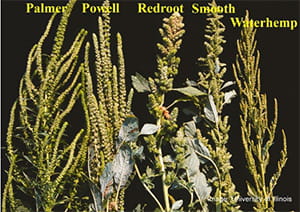
Invasive pigweeds can be difficult to distinguish from other pigweeds found on the prairies, but there are a few features to look for. Both palmer amaranth and waterhemp have smooth and hairless stems, while other pigweeds have hair on the stem surface. Additionally, both invasive pigweeds have long and narrow inflorescences that can vary between 15 and 60 centimeters long. Palmer amaranth has diamond-shaped leaves and the petioles are typically longer than the leaf blade. Waterhemp has narrow lanceolate-shaped leaves with wavy leaf margins in some cases and the petiole is shorter than the leaf blade.
Inflorescences of Different Pigweeds
Both invasive pigweed species are dioecious, meaning they have separate male and female plants, which gives populations high genetic diversity and a strong ability to develop herbicide resistance.
In North America, resistance to various combinations of Group 2, 3, 4, 5, 6, 9, 10, 14, 15 and 27 herbicides has been identified in palmer amaranth, while resistance to Group 2, 4, 5, 9, 14, 15 and 27 herbicides has been identified in waterhemp.
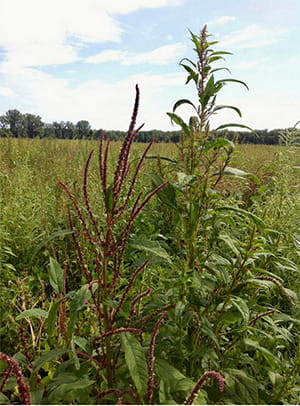
Palmer Amaranth in the field.
Male(left) and female(right)
Combinations of herbicide group resistance vary geographically, with the highest levels of resistance present in the southern and central United States, where they have been present for decades. Palmer amaranth populations in Canada are considered resistant to Group 2, 5, 6, 9,14 and 27 herbicides. Both species can produce hundreds of thousands of seeds per plant, which makes it essential to identify and control them early.
Seeds of invasive pigweeds can spread in numerous ways. Environmental factors like wind, water, wildlife and migratory birds can spread seeds. Invasive pigweed seeds can also spread through grain, livestock feed and equipment movement between regions.
Invasive pigweeds have migrated north and west in recent years and have been identified in various parts of North Dakota, Montana, Ontario and Manitoba. Since 2023, palmer amaranth has been confirmed in the Hill and Daniels counties of Montana that border southern Saskatchewan. Additionally, waterhemp has previously been found in the Manitoba rural municipality of Ellice-Archie, which borders eastern Saskatchewan.
Since these pigweeds are being found near Saskatchewan, the Ministry of Agriculture Weed Control Specialist, Cory Jacob, along with the Saskatchewan Association of Rural Municipalities (SARM) plant health technical advisors, surveyed numerous pulse and soybean fields in southern and eastern Saskatchewan for the presence of invasive pigweeds this summer. Fortunately, they did not find any invasive pigweeds and none have been identified in the province as of 2025. It’s important to note that palmer amaranth and waterhemp could be present in Saskatchewan, so producers and agrologists are encouraged to monitor fields for any suspicious pigweeds, especially in southern and eastern regions.
If you find plants that resemble palmer amaranth or waterhemp, please immediately contact Cory Jacob at 1‑306‑570‑1086 or the Agriculture Knowledge Centre at 1-866-457-2377 for further instructions. If the weed is determined to be an invasive pigweed, plants must be destroyed and eradicated.
We need your feedback to improve saskatchewan.ca. Help us improve