A number of pages on the Government of Saskatchewan's website have been professionally translated in French. These translations are identified by a yellow box in the right or left rail that resembles the link below. The home page for French-language content on this site can be found at:
Where an official translation is not available, Google™ Translate can be used. Google™ Translate is a free online language translation service that can translate text and web pages into different languages. Translations are made available to increase access to Government of Saskatchewan content for populations whose first language is not English.
Software-based translations do not approach the fluency of a native speaker or possess the skill of a professional translator. The translation should not be considered exact, and may include incorrect or offensive language. The Government of Saskatchewan does not warrant the accuracy, reliability or timeliness of any information translated by this system. Some files or items cannot be translated, including graphs, photos and other file formats such as portable document formats (PDFs).
Any person or entities that rely on information obtained from the system does so at his or her own risk. Government of Saskatchewan is not responsible for any damage or issues that may possibly result from using translated website content. If you have any questions about Google™ Translate, please visit: Google™ Translate FAQs.
2025 Grasshopper Populations
By Samantha Marcino, PAg, CCA, Crops Extension Specialist, Yorkton
December 2025
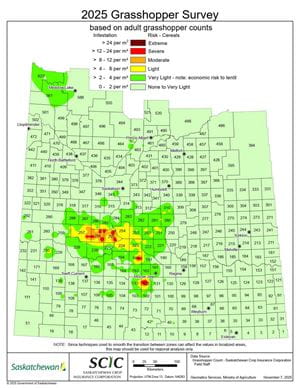
Grasshoppers remain a concern for producers as they can cause significant crop damage in a short time. The recently released 2025 Grasshopper Survey Map shows a few hotspots across the province; however, overall populations were less widespread compared to previous years. In 2025, approximately 1,149 sites were surveyed.
Looking ahead to 2026, it’s important to consider 2025 population levels, but other factors, such as temperature, precipitation and natural predators, will also play a key role in determining grasshopper numbers next year.
2025 Grasshopper Survey Map
A warm extended fall will allow more grasshopper eggs to be laid, along with greater embryo development, better survival and an earlier hatch in the spring. Very cold winter temperatures with little snow cover can result in mortality of grasshopper eggs but they tend to lay their eggs in areas where snow will accumulate.
Grasshopper eggs are laid in a foam that hardens into a tough case with hatching taking place over four to six weeks. Most pest species go through five nymphal instars before becoming mature winged adults. Scouting should begin in late May or June when hatching starts. This can be done by walking through field margins and observing the number of grasshoppers jumping along a transect. Cool weather can delay hatching, so timing may vary.
Different species have different feeding preferences. Economic thresholds vary by crop type but are typically 10 to 12 grasshoppers per square metre. Flax and lentils are more sensitive to feeding as the grasshoppers will clip off bolls and pods causing them to fall to the ground, as well as cause damage to flowers. The economic threshold in those two crops is much lower at two grasshoppers per square meter. Canola is more tolerant of grasshopper foliar feeding and the threshold is about 14 grasshoppers per square metre.
Grasshopper populations can sometimes be controlled by natural fungal diseases. One example is Entomophaga grylli, also commonly known as Summiting disease. Infected grasshoppers climb to the top of the plant, die, and releases sticky fungal spores as the body decomposes. These spores spread and infect other grasshoppers with the pathogen. This disease thrives in warm, humid summer conditions.
Grasshopper eggs, nymphs and adults are preyed upon by many insects, birds and mammalian generalist predators. Ground squirrels, in particular, love to eat them. Grasshoppers are also attacked by parasitic wasps and flies and can fall victim to bacteria and viruses.
Grasshopper infestations are hard to predict but scouting early in the spring and summer will help determine if control methods are required.
If you would like more information on the map, please contact your local crops extension specialist by calling the Agriculture Knowledge Centre at 1-866-457-2377.
We need your feedback to improve saskatchewan.ca. Help us improve