A number of pages on the Government of Saskatchewan's website have been professionally translated in French. These translations are identified by a yellow box in the right or left rail that resembles the link below. The home page for French-language content on this site can be found at:
Where an official translation is not available, Google™ Translate can be used. Google™ Translate is a free online language translation service that can translate text and web pages into different languages. Translations are made available to increase access to Government of Saskatchewan content for populations whose first language is not English.
Software-based translations do not approach the fluency of a native speaker or possess the skill of a professional translator. The translation should not be considered exact, and may include incorrect or offensive language. The Government of Saskatchewan does not warrant the accuracy, reliability or timeliness of any information translated by this system. Some files or items cannot be translated, including graphs, photos and other file formats such as portable document formats (PDFs).
Any person or entities that rely on information obtained from the system does so at his or her own risk. Government of Saskatchewan is not responsible for any damage or issues that may possibly result from using translated website content. If you have any questions about Google™ Translate, please visit: Google™ Translate FAQs.
Pre-Planning Your Acres
By Japjyot Sandhu, Crops Extension Specialist Intern, North Battleford
December 2025
When it comes to pre-planning your acres, it is important to conduct a comprehensive review of the previous season. Maintaining accurate records of crop varieties, pesticide applications and fertilizer usage is important for evaluating the profitability of each year's agricultural practices. Field issues such as weeds, disease and insect pressure should be documented, so that management practices can be reviewed, if required. Yield maps can also help record and identify areas that are consistently producing lower yields.
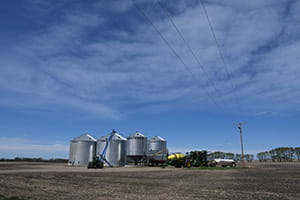
Grain bins and equipment ready for the next season
in Saskatchewan
It is also important to plan for crop inputs such as fertilizers and pesticides ahead of the next growing season. Purchasing them earlier may result in products being less expensive; however, this is not always the case. Post-harvest soil testing helps guide fertilizer decisions for the next year while reducing the chance of excess fertilizer application and nutrient losses. Using the right rate at the right time are two essential elements of 4R (Right Source @ Right Rate, Right Time, Right Place®) nutrient stewardship.
Early crop planning begins with developing a solid crop rotation plan and seed selection. Start by cleaning seed for the following year and do a seed test to ensure well-established crops in the upcoming growing season. Forecast your seed needs, preorder and purchase certified seeds to ensure they are available during seeding time. When choosing crop varieties, use the SaskSeed Guide or talk to a sales representative to determine which varieties are suitable for the region. Consider seed treatments to help reduce the risk of seed and soil-borne diseases, as well as insect damage to crops. The Crop Planning Guide can help you expand your rotation by providing information on general agronomic and economic factors.
There are many benefits to a diverse crop rotation including breaking the pest cycle, enhancing soil health and offering market diversification opportunities that mitigate economic risk. Growers should monitor herbicide use carefully, as some can have residual effects that influence crop choices for the following year. Additionally, rotating herbicide groups is important to reduce herbicide resistance. More information on herbicide residuals, crop restrictions and much more can be found in the 2025 Guide to Crop Protection.
If you want to learn more about crop planning, please contact your local crops extension specialist or the Agriculture Knowledge Centre at 1-866-457-2377.
We need your feedback to improve saskatchewan.ca. Help us improve