A number of pages on the Government of Saskatchewan's website have been professionally translated in French. These translations are identified by a yellow box in the right or left rail that resembles the link below. The home page for French-language content on this site can be found at:
Where an official translation is not available, Google™ Translate can be used. Google™ Translate is a free online language translation service that can translate text and web pages into different languages. Translations are made available to increase access to Government of Saskatchewan content for populations whose first language is not English.
Software-based translations do not approach the fluency of a native speaker or possess the skill of a professional translator. The translation should not be considered exact, and may include incorrect or offensive language. The Government of Saskatchewan does not warrant the accuracy, reliability or timeliness of any information translated by this system. Some files or items cannot be translated, including graphs, photos and other file formats such as portable document formats (PDFs).
Any person or entities that rely on information obtained from the system does so at his or her own risk. Government of Saskatchewan is not responsible for any damage or issues that may possibly result from using translated website content. If you have any questions about Google™ Translate, please visit: Google™ Translate FAQs.
Fall Application of Herbicides
By Quinton Cubbon, Crop Extension Specialist, Regional Services, North Battleford
October 2025
Now that harvest is complete, producers are returning to the field to control weeds for the following spring with foliar herbicide applications or granular products. Timelines are tight prior to winter, but it’s important to consider which weeds are present and will benefit from fall herbicide applications. Fall management of weeds such as wild oats, thistles and kochia will result in improved weed control in the following spring and can also terminate crop regrowth and late seeds germinating post-harvest.
Germinated Fall Weeds
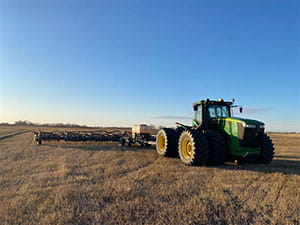
Tractor with Valmar on a harrow bar
Each year, combines drop grain out of the back. No matter how well a combine is calibrated, there will inevitably be harvest losses. Canola tends to have significantly more harvest loss than wheat. Producers typically prefer to keep harvest losses under a bushel per acre, although half a bushel is more ideal. Breaking it down, half a bushel per acre of canola equates to about 25 pounds, assuming a bushel weight of 50 pounds. Typically, producers seed between four to seven pounds per acre in the spring. Even if only a quarter of the seeds germinate in the fall, that would be roughly six pounds per acre. A heavy frost may take up to a month to arrive; in the meantime, volunteer canola can take up valuable soil nutrients. Volunteer crops are generally easy to control and, in such instances, using straight glyphosate may be sufficient. In some cases, a tank mix might be necessary to target a broader range of weeds or if glyphosate-resistant weeds are present.
Thistles can be problematic throughout the growing season. Applying a high rate of glyphosate in the fall after harvest, as temperatures begin to cool, can be an effective approach. As the temperatures drop, thistles begin translocating sugars to their roots, which will also move the glyphosate more easily into the root system, resulting in better control. Thistles can also be controlled using pre-harvest glyphosate application, but it’s essential to allow enough time for the herbicide to take effect; otherwise, efficacy can be reduced. It’s recommended to wait a minimum of 10-14 days between glyphosate application for pre-harvest weed control and harvesting, to allow the active ingredient time to act on the weeds.
Preplanning for Spring
Several products can be applied in the fall for spring weed control. The recent focus has been on targeting weeds such as kochia and wild oats. Products containing active ingredients like ethafluralin, triallate and pyroxasulfone have strong residual effects and can control a broad range of weeds.
When applying these products, the recommended soil temperature is around 4 C. Applying them as late as possible tends to yield better results in the spring. These products are moisture-activated, so as snow melts in the spring, control improves. If there is minimal snow melt, rain will be needed for activation or control may be reduced.
Granular products, like ethafluralin and triallate, require two incorporations to mix the herbicide into the soil for optimal control. These active ingredients need to be placed in the germination zone of the weed seeds to inhibit germination or kill germinating weeds, depending on the product. In contrast, surface-applied liquid formulations like pyroxasulfone should not be incorporated with a harrow, as this could reduce the product’s efficacy. It is essential that before applying any product read the label guidelines for rates and re-cropping restrictions.
For more information on fall-applied herbicides, please reach out to your local crops extension specialist or the Agriculture Knowledge Centre at 1-866-457-2377.
We need your feedback to improve saskatchewan.ca. Help us improve