A number of pages on the Government of Saskatchewan's website have been professionally translated in French. These translations are identified by a yellow box in the right or left rail that resembles the link below. The home page for French-language content on this site can be found at:
Where an official translation is not available, Google™ Translate can be used. Google™ Translate is a free online language translation service that can translate text and web pages into different languages. Translations are made available to increase access to Government of Saskatchewan content for populations whose first language is not English.
Software-based translations do not approach the fluency of a native speaker or possess the skill of a professional translator. The translation should not be considered exact, and may include incorrect or offensive language. The Government of Saskatchewan does not warrant the accuracy, reliability or timeliness of any information translated by this system. Some files or items cannot be translated, including graphs, photos and other file formats such as portable document formats (PDFs).
Any person or entities that rely on information obtained from the system does so at his or her own risk. Government of Saskatchewan is not responsible for any damage or issues that may possibly result from using translated website content. If you have any questions about Google™ Translate, please visit: Google™ Translate FAQs.
Unlocking Agricultural Efficiency Through Yield Mapping
By Japjyot Singh Sandhu BSA, AAg, Crops Extension Intern, North Battleford
September 2025
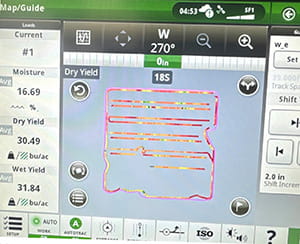
The growing season is coming to an end and harvest is in full swing across the province. As the combines roll through the fields, they gather valuable yield data. Yield map data can be used to visualize and understand the productive and non-productive regions within the fields. This data can be automatically uploaded to the cloud (online), where it can be accessed and downloaded for analysis post-harvest. In cases where the combination lacks cloud storage, data can be manually downloaded for analysis. The yield maps can provide insight into the outcome of management practices that were implemented in previous years.
Yield map generated in real time during harvest
Yield maps are valuable tools for understanding variability in different areas in the field, such as low-lying areas and knolls. Yield maps can help identify various zones within fields, such as consistently marginal and productive areas. These zones can then be managed using different practices, allowing for the reduction of inputs, such as fertilizers, in zones that consistently produce lower yields.
A yield map can highlight areas that generally produce optimal yields based on historical data, that may have a nutrient deficiency and should be soil tested. When conducting soil testing, it is important to sample marginal areas along with productive areas to gain a thorough understanding of nutrient availability for the following year, thus reducing the risk of over-application of nutrients. This approach helps achieve two of the 4Rs of nutrient stewardship: the right place and the right rate.
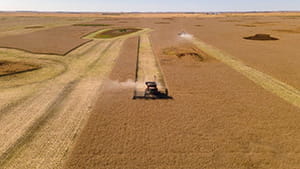
A red combine harvesting a ripe fieldFurthermore, multi-year yield maps offer valuable insights into the productivity of different crops and yield trends of different varieties over the years. This information helps refine the selection of varieties and seeding rates for different zones and inputs based on historical yield data. Using yield maps, variable rate applications can be developed, which can help reduce the amount of seed and fertilizer used in less productive marginal zones and may allow for alternative management options. Additionally, variable-rate seeding can help reduce input costs as fertilizer and seed prices continue to rise.
Please, contact your local crops extension specialist or the Agriculture Knowledge Centre at 1-866-457-2377 for additional information.
We need your feedback to improve saskatchewan.ca. Help us improve