
By Andre Bonneau, PAg, Range Management Extension Specialist, Prince Albert
May, 2026
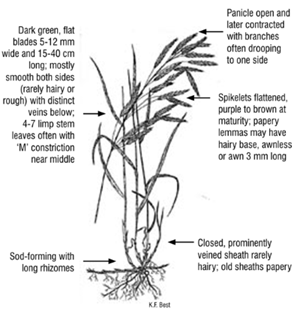
(Sask Forage Council)
Smooth brome (Bromus inermis) is a perennial, cool-season, rhizomatous grass native to eastern Europe and China. It was introduced to Saskatchewan in the 1880s and became widely used in the 1930s for both forage and erosion control during severe drought. Smooth brome is palatable, nutritious and has high tolerance to drought, salinity, disease and cold temperatures which makes it productive in many environments.
These same traits that make it a hardy and beneficial plant can also contribute to its ability to invade native rangelands. Its early spring growth, aggressive creeping root system, prolific seed production and ability to use water and nutrients efficiently give smooth brome a strong competitive advantage over native plants. As smooth brome increases, native species are often outcompeted, which leads to a plant community dominated by smooth brome and a decrease in biodiversity.
Control of smooth brome encroachment has been researched but is not well understood. Below are a few methods that may slow smooth brome from taking over a native stand.
Heavy grazing or grazing combined with mowing:
- Smooth brome should be grazed before stem elongation to limit regrowth. Repeated grazing before elongation will draw down carbohydrates in the root system and reduce plant vigour.
- Defoliation at other times can stimulate new tillers to grow and support full recovery of the plant.
Spring burning:
- Spring burning removes litter and injures actively growing plants. Like early grazing, fire will cause the brome to regrow and draw down carbohydrate reserves.
- Burning alone is likely not enough to control smooth brome.
- Fire can damage all plants so there’s a risk native plants can be suppressed including smooth brome.
Herbicide application:
- Glyphosate can suppress smooth brome, especially when it’s applied prior to flowering or used in combination with prescribed fire.
- The long-term results of glyphosate application depend on the ability of the native species to fill in and compete after the brome has been sprayed.
- Chemical control can also encourage other invasive species by opening bare ground.
In summary, no single control method reliably eliminates smooth brome from invaded rangelands. Using a combination of methods like grazing, fire and herbicide offers the greatest potential for maintaining rangeland diversity. It is also important to monitor your rangelands and adjust the control methods for better results.
If you have concerns with smooth brome on your native pasture, identify those areas and contact your local range management extension specialist at 1‑866‑457‑2377 to discuss options to manage those patches.