
By Andre Bonneau, PAg, Range Management Extension Specialist, Prince Albert
May 2026
Crested wheatgrass is a productive tame forage that has been planted on millions of acres across the Canadian prairies. However, one of the challenges with crested wheatgrass is that it has the potential to invade native rangelands and damage the pasture’s ability to withstand difficult growing conditions.
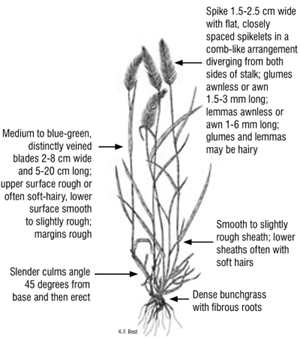
(Sask Forage Council)
Crested wheatgrass begins growth early in the season, often before many native plants. As crested wheatgrass patches expand, they often form dense monocultures with low plant diversity. These simplified communities are less hardy during drought and provide reduced habitat quality for wildlife, pollinators, small mammals and birds. There are things you can do to prevent crested wheatgrass from invading native plant communities:
- Preventing crested wheatgrass from going to seed is crucial to managing its spread. Early and heavy grazing during tiller elongation is most effective, as it suppresses root growth, reduces plant vigour and limits seed production. Grazing can slow down invasion, but it rarely gets rid of the species altogether. There’s also a risk of overgrazing the native plants.
- Mowing can be effective when cut down to four inches during elongation. Repeated treatments can reduce vigour over time and prevent seed set, though effectiveness depends on equipment, timing and follow-up management.
- On its own, prescribed fire usually is usually ineffective because crested wheatgrass reestablishes quickly. However, it can enhance other treatments by improving the effectiveness of herbicides. Fire causes all the crested wheatgrass to regrow uniformly which makes herbicide treatments more effective since actively growing plants are easier to control.
- Herbicides like glyphosate can be used strategically at the flowering stage, before seeds form, to knock back crested wheatgrass. However, it often grows back quickly, so multiple applications of herbicide are typically needed. Take care when using glyphosate alone as it rarely provides long-term control and may remove most of the native plants. Creating bare ground favours reinvasion of crested wheatgrass or other undesirable plants.
Overall, crested wheatgrass is hard to get rid of once it’s established. Over time, using a mix of methods – like reducing seed production, managing grazing and carefully using fire and herbicides – can help control its spread, reduce how dominant it is and still support healthy native grasslands.
If you have concerns with crested wheatgrass encroaching on your native pasture, identify those areas and contact your local range management extension specialist at 1‑866‑457‑2377 to discuss options to manage those patches.