
By Andre Bonneau, PAg, Range Management Extension Specialist, Prince Albert
May, 2026
Kentucky bluegrass (Poa pratensis) has become a problem in Saskatchewan. It invades healthy, undisturbed native grasslands and forms thick stands that crowd out native grasses and flowering plants. Kentucky bluegrass also creates a mat of dead grass which blocks sunlight, slows water movement into the soil and limits the growth of native plants.
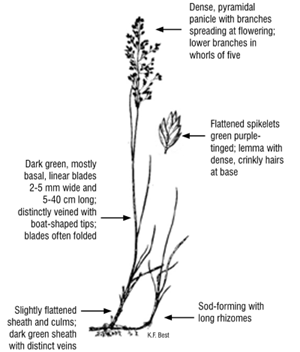
(Sask Forage Council)
Kentucky bluegrass is a cool-season perennial grass that can persist for many years once established. It’s use as turf grass, forage for livestock and erosion control has led to Kentucky bluegrass being found all through the Canadian prairies. Kentucky bluegrass is commonly seeded in perennial pastures, increasing the number of seeds available to invade nearby native rangelands.
Although Kentucky bluegrass can provide forage in spring, summer and fall, it performs poorly during drought because of its shallow root system. Over time, it tends to replace diverse plant communities with nearly pure stands.
Managing Kentucky bluegrass is challenging because it has a similar growth pattern of native cool-season grasses. Early intensive grazing before heading can limit early growth and reduce litter buildup. A late fall or early spring fire followed by intensive grazing before heading, can temporarily reduce bluegrass cover. Results are short-lived unless treatments are repeated. Combining fire with non-selective herbicides has shown better short-term results, but removing native plants can lead to the establishment of other undesirable plants.
Overall, Kentucky bluegrass reduces native plant diversity, alters ecosystem processes and complicates prairie management. Long-term success will require integrated, region-specific approaches that balance grazing, fire, and other tools to maintain healthy prairie ecosystems.
If you have concerns with Kentucky bluegrass on your native pasture, identify those areas and contact your local range management extension specialist at 1‑866‑457‑2377 to discuss options to manage those patches.