
By Japjyot Sandhu, M.Sc., A.Ag, Extension Agrologist Intern, North Battleford
May 2026
As seeding progresses in the province and canola starts emerging, so will pests. Flea beetles are one of the most consistent early-season pests that damage canola and other brassica crops. Flea beetles start to feed early on emerging canola seedlings at the cotyledon to four-leaf stages, when they are most vulnerable. During sunny, warm and dry weather with temperatures above 14 C, feeding becomes more intense, leading to uneven crop stands and reduced seed yield. In severe cases, reseeding may be required.
Spotting flea beetle damage early is key to an effective management strategy. When scouting for flea beetles, inspect areas where they can overwinter, such as ditches, shelterbelts and the surface of leaf litter and grasses. When scouting near these areas, check for small holes in leaves and cotyledons. Under windy, cool and damp conditions, flea beetles tend to take cover, which may lead to feeding young stems or the undersides of leaves. Conduct a thorough scouting in an M-shaped pattern throughout the field to get a good sense of where insects are causing damage.

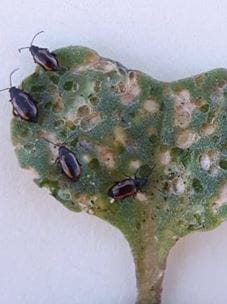
on canola seedling
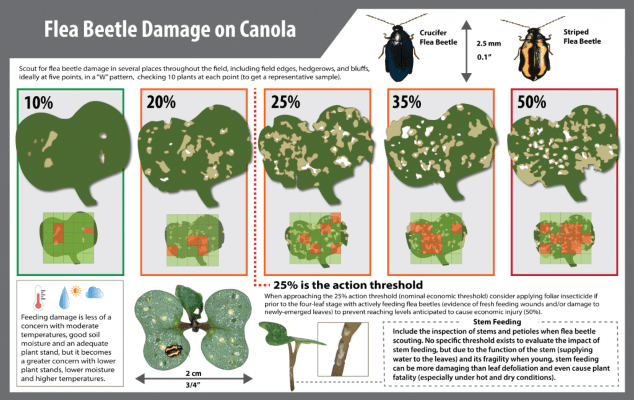
Control of flea beetles relies on a combination of strategies. Seed treatments are typically the best defence as the seed emerges and they become active once seeds absorb moisture and commonly protect the seedling for three to four weeks. High levels of flea beetle pressure can overwhelm this treatment, especially on slow-growing plants. Frequent scouting is required for the first few weeks and if damage reaches an action threshold of 25 per cent or more as shown below, a post-emergent insecticide application may be required. The list of seed treatments and foliar application options can be found in the 2026 Guide To Crop Protection.
Cultural control strategies can be implemented for future growing seasons, when flea beetle pressure is anticipated to be high, including using good-quality canola seed and seeding at shallower depths (into available moisture) for quick germination. If possible, select varieties that are vigourous and can tolerate flea beetle feeding more than less vigourous varieties. Directly seeding into standing stubble will provide a micro-climate that will help promote rapid seedling growth and due to its shaded, cooler environment, it is less favourable for feeding. Increasing seeding rates will help reduce feeding damage per plant and enable quicker recovery.
For more information on scouting and managing flea beetles this spring, contact your local crops extension specialist or the Agriculture Knowledge Centre at 1‑866‑457‑2377.