
By Tess Versluis, Summer Student, Humboldt
May 2026
Join the crops extension specialists for another Crop Diagnostic School, happening on July 29 and 30, 2026, in Swift Current, Sask.
Crop Diagnostic School is a field day at one of Saskatchewan’s Agri-ARM sites, where we demonstrate and discuss many topics in Saskatchewan crop production. This is a great opportunity to network and learn new crop scouting skills from provincial specialists and researchers. This year, the Ministry of Agriculture is proud to partner with the Wheatland Conservation Area (WCA) in Swift Current, to host this event. Participants will only need to attend one day, as the same material will be covered on both July 29 and 30. Space is limited, so be sure to register early to reserve your spot!
Program Leadership and Delivery
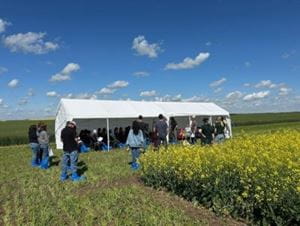
Each year, the Ministry of Agriculture’s crops extension specialist team plans and delivers Crop Diagnostic School, including developing and updating the Crop Diagnostic School Handbook to ensure it provides current, practical agronomic information.
Based in 10 regional offices across the province, crops extension specialists offer unbiased agronomic advice on crop management and share updates through extension events in the region.
If you are unable to attend Crop Diagnostic School, please reach out to your local crops extension specialist to learn about other training opportunities in your area.
Program Content and Learning Objectives
Crop Diagnostic School will have five different stations where participants can listen to short presentations, view demonstration material and practice technical field scouting skills with experts. The five stations include:
- Weed Identification: This station will cover commonly confused weed species, herbicide resistant weed testing and plant identification services available through the crop protection lab. It will also include current herbicide resistance issues and integrated pest management strategies in Western Canada. Plot demonstrations will give participants hands-on practice with weed identification.
- Disease: Participants will join pathologists from the University of Saskatchewan and ministry specialists to learn about diseases and crop issues being seen this year. Discussions will include disease diagnosis and management in pulses, cereals and canola. The station also has hands-on disease scouting in canola, wheat, chickpea and lentil plots.
- Insects: This station will focus on identifying and managing key insect pests across various crop types. Participants will learn from entomologists as they guide participants through scouting and identifying insects found in the plots and sweep nets.
- Herbicide: The station will feature two demonstrations. One includes herbicide tank-mix compatibility and how interactions affect efficacy. The second demonstration will show participants key crop injury symptoms caused by different herbicide groups, with a comparison of the performance of Group 1 and 2 graminicides on wild oats, using tame oats for visual contrast.
- Soils: This station will feature hands-on demonstrations focused on organic amendments, 4R nitrogen management and soil profile diagnostics. Participants will learn how organic amendments improve soil moisture retention and reduce nutrient leaching, examine crop responses to different nitrogen rates, timing and placemen, and interpret soil properties through a soil pit by identifying horizons, soil-forming factors and key diagnostic features.
You can find additional information on the stations and presenters on the Crop Diagnostic School registration page. For more information about Crop Diagnostic School, contact your local crops extension specialist or call the Agriculture Knowledge Centre at 1-866-457-2377.