
Claire Ledingham, Public Trust Specialist, Public Trust Unit, Regina
Picture lush, rolling green fields dotted with white sheep. You may be picturing Ireland or Scotland, but this sight can be increasingly found in Saskatchewan. Sheep may not be the first animal you picture when you think of Saskatchewan’s livestock industry, but they play an important role and their distinctive products are one-of-a-kind.
Gord Schroeder of the Saskatchewan Sheep Development Board knows wool is a unique, natural product, which is why he partnered with The Campaign for Wool to spotlight Saskatchewan wool. Through the support of the Agriculture Awareness Initiative Program, Gord collaborated with The Campaign for Wool to create an eight-minute video titled “Fabric of Canada: Woolkeepers of Saskatchewan.” The video follows wool production from the sheep farm to the fibre mill to the final products of yarn, bedding and tapestries.
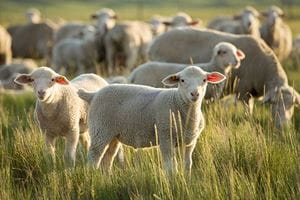
In the video, Her Honour the Honourable Bernadette McIntyre, S.O.M., Lieutenant Governor of Saskatchewan, explains that wool is one of King Charles’ top initiatives. The King recognizes that wool is a sustainable and natural product that should be celebrated. This is why Mariette Anderson, a Saskatchewan knitter, was asked to make scarves for the King and Queen using wool yarn from the Canadian Fibre Mill located in Caron, Saskatchewan. The Canadian Fibre Mill is supplied with wool from sheep farmers like Brooke Aitken and Chris Howard of Loch Lomond Livestock near Eyebrow. Brooke and Chris are proud to be raising sheep in Saskatchewan, knowing the importance of livestock to the landscape. They are particularly interested in rotational grazing and other regenerative practices. Brooke explains the excitement of being a sheep farmer is getting to witness her animals “turn sunshine into meat and wool.”
A premiere for the video was held in October 2025 at Government House in Regina. The event, which also helped celebrate Wool Month, attracted 75 guests, including wool industry representatives and local media. Following the premiere, the video was released to the public to encourage a deeper understanding of the wool industry in Saskatchewan. To date, the video has over 29,000 views and 50 comments on YouTube, illustrating its wide reach.
When asked why the Saskatchewan Sheep Development Board wanted to collaborate on this video, Gord Schroeder explained: “We need to share what we do and bring awareness to our stories of innovation and production.”
Celebrating Saskatchewan’s agriculture stories with the public is important for all sectors. Schroeder believes that the more the public knows about agriculture products and how they are grown, the more trust they will have in agriculture producers and the food system.
The Agriculture Awareness Initiatives Program is funded through the Sustainable Canadian Agricultural Partnership between the federal and provincial governments. The program provides support to build awareness and trust in modern agriculture and to help individuals and organizations tell Saskatchewan agriculture’s sustainability story.
For more information on the Agriculture Awareness Initiative Program, visit saskatchewan.ca/S-CAP. To watch the video, visit The Campaign for Wool website.