A number of pages on the Government of Saskatchewan's website have been professionally translated in French. These translations are identified by a yellow box in the right or left rail that resembles the link below. The home page for French-language content on this site can be found at:
Where an official translation is not available, Google™ Translate can be used. Google™ Translate is a free online language translation service that can translate text and web pages into different languages. Translations are made available to increase access to Government of Saskatchewan content for populations whose first language is not English.
Software-based translations do not approach the fluency of a native speaker or possess the skill of a professional translator. The translation should not be considered exact, and may include incorrect or offensive language. The Government of Saskatchewan does not warrant the accuracy, reliability or timeliness of any information translated by this system. Some files or items cannot be translated, including graphs, photos and other file formats such as portable document formats (PDFs).
Any person or entities that rely on information obtained from the system does so at his or her own risk. Government of Saskatchewan is not responsible for any damage or issues that may possibly result from using translated website content. If you have any questions about Google™ Translate, please visit: Google™ Translate FAQs.
New Year, New Farm Technology
By Adriane Good, M.Sc., PAg, Livestock and Feed Extension Specialist
December 2025
As we look forward to 2026, many producers are looking for ways to improve their operation. Whether it be saving feed or labour, there are several technologies emerging on the market promising benefits for the ranchers that use them.
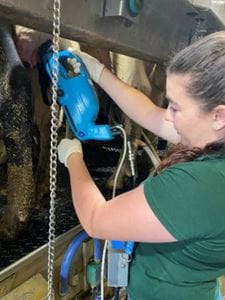
Livestock and Feed Extension Specialist using
an acoustic pulse applicator on a cow.
Livestock and feed extension specialists have used funding available through the Agricultural Demonstration of Practices and Technology (ADOPT), funded at a rate of 60 per cent federally and 40 per cent provincially under the Sustainable Canadian Agricultural Partnership, to demonstrate new technologies and have learned many lessons along the way. When making decisions for your own operation, the following questions can help you decide if a new technology is right for you.
Know Where the Technology Comes From
While some things are universal when it comes to livestock production, production differences across the world may affect how well technology works here. The recently completed project ‘The Effect of Acoustic Pulse Technology on Prevention of Mastitis in Dairy Cattle’ used a technology developed in Israel that’s gaining popularity in Wisconsin. While the science behind the technology is promising, Saskatchewan is quite different from Wisconsin, so the technology was not practical here. On the other hand, ‘Remote water quality monitoring with FarmSimple technology’ was a project that successfully demonstrated a technology developed in Saskatchewan for Saskatchewan producers to monitor water quantity and quality in remote pastures.
Know the Cost of Use
Some technologies seem low-cost at first but can surprise you with other costs when it comes to implementing them. Technologies that use cell phone towers can be more expensive than originally planned, because you may have to pay to access those towers, adding significantly to the cost. Also, think about any extra infrastructure or facilities you may need to use the technology. In the ‘Growing Fodder as an Alternative Feed Source’ project, technology costs added up quickly when the cost of the fodder growth system were included.
Think About the Practicality
When investigating one new technology for pain reduction at castration for lambs and discussing the technology with producers, one pointed out a seemingly innocuous roadblock: it required another applicator. Another applicator may not seem like a big deal, however bringing two separate tools to castrate and tail dock lambs instead of one could be a hindrance to producers. Thinking about seemingly small practicalities can help you decide whether to use the new technology.
Check the Research
New production methods or technologies being analyzed in a peer-reviewed research journal can lend credibility to the technology. The project ‘Commercial Replacement Heifer Selection Using Genomic Testing’ used commercially available genomic tests that have been based on several years of genetic research to aid in breeding stock selection. The scientific research behind these tests show that some traits are highly heritable, so the genomic tests can be very useful in selection. Not being published in a peer-reviewed journal doesn’t necessarily mean the technology isn’t worth your time, but being published can add another layer of trust to the practice.
Understand What You Save
This could be time, money, animal health or a combination of the three. Think critically about the cost of the technology and the practicality of it. For example, the project ‘Efficacy of Field-Side Nitrate Testing’ tested handheld nitrate meters that would allow producers to test nitrates of their crops within minutes, instead of taking a few days. Potential time savings from the meter were negated when 20 per cent of the results were false negative – which could result in feeding high nitrate feed to livestock and in turn, lost calves, leading to a net loss of money.
Experimenting with new technologies and practices can be beneficial for your farm, as some ADOPT projects done by the livestock and feed extension specialist team have shown. When looking at technology or practices to implement on your farm, think critically through the sales pitch and ask questions. Technologies that are developed in Western Canada, low cost, practical, and published may be hard to find, but they can be an advantage to your operation. For more information about past ADOPT projects or to discuss implementing new technology on your farm, contact the Agriculture Knowledge Centre at 1-866-457-2377.
We need your feedback to improve saskatchewan.ca. Help us improve