
By Chelsey Siemens MSc., PAg, Livestock and Feed Extension Specialist, Kindersley
February 2026
Selecting replacement heifers, either from your own herd or to purchase, has a major impact on future success. Developing those heifers also comes at a significant cost. It can be difficult to decide which heifers will possess the right genetic makeup to become successful cows on a particular operation. Fertility, mothering ability, soundness, feed efficiency and longevity in the herd are all important factors but are hard to determine when looking at a heifer that is one year old or younger. Many of the desirable traits that a beef producer is looking for in a heifer can’t be seen or measured until after that heifer has had at least one calf. Many of the traits of interest depend on both genetic and non-genetic factors. There are some tools available to producers that can help bridge this gap in information and can help to support confident decisions when selecting heifers.
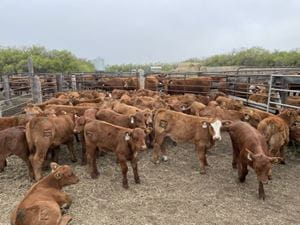
with ear tags and brand marks
Ministry livestock and feed extension specialists are currently working on a demonstration project funded by the Agriculture Demonstration of Practices and Technology (ADOPT) program, evaluating the use of genomic testing for replacement heifer selection on commercial beef operations. For this project, ear tissue samples were collected from heifer calves at branding time and sent to Neogen Canada where the Igenity Beef genomic test was performed. This test provides scores for 17 traits including maternal (birth weight, direct calving ease, maternal calving ease, stayability, heifer pregnancy rate, docility and milk), production (residual feed intake, average daily gain, weaning weight, yearling weight and scrotal circumference) and carcass (tenderness, marbling, ribeye area, fat thickness and hot carcass weight) characteristics. Depending on the trait, a score between zero or one and 10 is assigned for each trait depending on the genotypes of each calf. Each heifer calf received a score for each individual trait plus three indices which rank the heifer calves on a combination of either maternal, production and terminal traits. The index most closely representing the goals of the operation can be considered when selecting replacement heifers. The producers participating in this project all wish to produce replacement heifers with strong maternal traits while also producing steer calves that will perform well as market animals. For this reason, they would most likely use the production index, which includes both maternal and growth traits in their selection process.
The intent of the project was to evaluate whether receiving the genomic data for heifer calves early in their lives could be used to identify replacement heifers that would meet the breeding goals of each unique operation. The heifers identified as being superior for each trait were compared against the list of replacement heifers chosen through the traditional methods of each ranch, which included visual appraisal, individual growth and performance and past performance of the heifers’ sire, dam and siblings. The trial cooperators evaluated their experience collecting tissue samples and reviewing genomic test results to determine whether the extra data would be an asset for heifer selection and whether the process of genomic testing fit into their usual handling activities.
As part of this project, tissue samples were also collected from herd sires at each ranch and parentage testing was done, providing information on the sire of each heifer calf. This process can help to identify productive or non-productive bulls and determine which bulls are siring the heifers with desirable traits.
While this project is still in progress, the results to date indicate that the producers find parentage data valuable to them and the tissue collection process fits in well with existing cattle handling events. Results are still being evaluated on the similarities or differences between the top heifers identified through genomic testing compared to those chosen by the producer through traditional methods. Genomic testing is one tool that can be used to gather more information on heifers early in life and can be used in combination with conformation, individual performance and performance of relatives to identify heifers that will develop into successful cows that meet the goals of a commercial beef operation.
For more information contact your nearest livestock and feed extension specialist by calling the Agriculture Knowledge Centre at 1-866-457-2377.