A number of pages on the Government of Saskatchewan's website have been professionally translated in French. These translations are identified by a yellow box in the right or left rail that resembles the link below. The home page for French-language content on this site can be found at:
Where an official translation is not available, Google™ Translate can be used. Google™ Translate is a free online language translation service that can translate text and web pages into different languages. Translations are made available to increase access to Government of Saskatchewan content for populations whose first language is not English.
Software-based translations do not approach the fluency of a native speaker or possess the skill of a professional translator. The translation should not be considered exact, and may include incorrect or offensive language. The Government of Saskatchewan does not warrant the accuracy, reliability or timeliness of any information translated by this system. Some files or items cannot be translated, including graphs, photos and other file formats such as portable document formats (PDFs).
Any person or entities that rely on information obtained from the system does so at his or her own risk. Government of Saskatchewan is not responsible for any damage or issues that may possibly result from using translated website content. If you have any questions about Google™ Translate, please visit: Google™ Translate FAQs.
Considerations for Including Corn in Winter Grazing
By Natasha Wilkie, PAg, Livestock and Feed Extension Specialist, Weyburn
December 2025
Corn can be an excellent option for meeting your livestock’s energy needs during the winter months. However, there are a few considerations to keep in mind when determining if it is the right option for your operation. Below, are some things to consider when grazing corn.
Chopping corn into swaths for grazing
One of the main risks of grazing corn is acidosis which occurs when ruminant animals (cattle, sheep, bison, goats, etc.) suddenly change from a diet high in fibre or roughage feed (hay, greenfeed) to a low fibre, high concentrate feed (barley, wheat, corn). The main goal when grazing corn is to take the necessary precautions so that this does not happen. If you are planning to use corn for winter grazing, it is very important to know the maturity of your corn. As the plant matures, energy density increases. A mature plant will also likely have thicker stalks, so the animals will want to eat the appetizing cobs, rather than the stalks, which are less palatable.
To lessen the significant changes in your animal’s diet when grazing corn, you can limit their access by providing three days of grazing at a time. This will minimize their ability to eat only cobs and will encourage your animals to eat the entire plant, keeping an even plane of nutrition while encouraging them to clean up what is there. Providing good quality hay, free choice, can also significantly reduce the risk of acidosis when grazing standing corn.
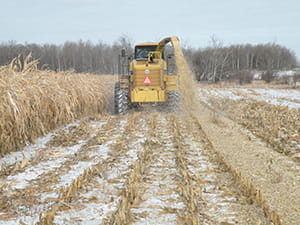
One rancher in the southeast chopped his corn into rows with a six-row header and combined the swaths so that 12 to 18 rows were placed into one swath. His goal was to have bulkier swaths to offer more product and decrease waste while providing his cows with an even plane of energy with each bite. Once the corn was chopped into swaths, he cross-fenced so the animals had access to three days of grazing, which eventually was expanded to one week. As in all scenarios, this practice has some potential drawbacks. For instance, if a large snowfall happened, the swaths could be covered or freeze/thaw cycles could mean parts of the chopped corn are embedded in ice and not available to the animal.
While there are additional considerations to think about when grazing corn, knowing the maturity and nutrient content of your corn, as well as limiting paddock size are important considerations to reduce the risk of acidosis or grain overload. For a deeper dive into the pros and cons of grazing corn, check out this factsheet. For more information about using corn in your winter-feeding system, contact your nearest livestock and feed extension specialist or phone the Agriculture Knowledge Centre at 1-866-457-2377.
We need your feedback to improve saskatchewan.ca. Help us improve