
By Tony Playter, freelance writer
Reproductive failure remains a big concern for Saskatchewan’s beef and dairy producers. Missed pregnancies, calf losses and low fertility rates aren’t just herd health problems, they directly affect productivity and profitability.
Dr. Yanyun Huang, Chief Executive Officer of Prairie Diagnostic Services Inc. (PDS) and adjunct professor at the Western College of Veterinary Medicine, has been leading the development of an innovative genomic sequencing tool designed to help solve this challenge.
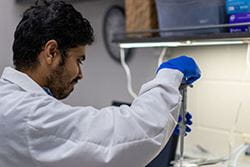
for Prairie Diagnostic Services Inc. (PDS)
The Bovine Reproductive Syndromic Sequencing Panel (BovReproSeq) has the potential to detect multiple pathogens linked to reproductive failure, all in a single test.
“The exact cause of reproductive issues in cattle can be very difficult to diagnose,” says Huang. “Traditionally, when there’s a problem in the herd, producers call their vet, and then tests are done on one or two pathogens. That approach doesn’t always provide an answer.”
This uncertainty is costly. An inconclusive test leaves producers guessing, while open cows and calf losses cut into the financial bottom line. Historically, the success rate for diagnosing abortion in cattle has been low.
That’s where syndromic sequencing changes the game. Instead of testing for one or two possibilities, BovReproSeq screens an entire panel of pathogens at once. This broader approach increases the chance of finding the correct diagnosis and making timely treatment decisions. This, in turn, can help producers avoid devastating losses.
“With the Bovine Reproductive Syndromic Sequencing Panel, we can test all the key pathogens together,” says Huang. “By testing the whole panel at once, we take out a lot of the human guesswork and provide producers with a clearer path forward. In the long run, that means more accurate results and lower overall costs.”
Huang credits funding from the Agricultural Development Fund (ADF) – a federal/provincial fund managed by the Ministry of Agriculture – as a catalyst for the project.
“The ADF support allowed us to leverage matching funds from the Beef Cattle Research Council,” Huang explains. “Without these two key funding resources, this powerful technology wouldn’t be available to the industry today.”
“I also would like to credit our research team, Dr. Janet Hill, professor and department head of Veterinary Microbiology, and our molecular biologist, Dhinesh Periyasamy. It is a team effort, and without them, BovReproSeq would not have come to fruition,” adds Huang.
For producers, the benefits of BovReproSeq are straightforward: better diagnostic accuracy, fewer wasted tests and stronger herd productivity. As Huang puts it, “The more precise we can be in identifying what’s happening in the herd, the better the chances producers have of protecting both their cattle and their bottom line.”
To learn more about Dr. Huang’s work and BovReproSeq, visit the PDS website or email pds.info@usask.ca.