
By Tony Playter, freelance writer
Focus on Tradition and Innovation Leads to Success for Brady and Lindsay Funk
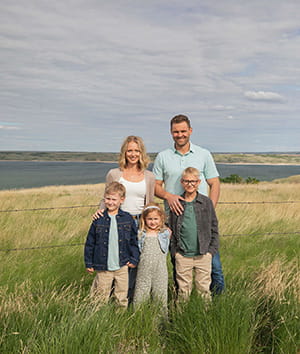
Brady and Lindsay Funk do not see themselves as extraordinary. To them, life is about faith, family and work. But earlier this year, their steady dedication to those priorities earned them recognition as Saskatchewan’s 2025 Outstanding Young Farmers, a title they accepted with humility at Canada’s Farm Show.
“It was a surreal moment hearing our names called,” Brady says. “We’re grateful just to be where we are today. Saskatchewan has so many incredible producers to learn and grow with. For us, it’s about serving, partnering and building a team with others around us.”
For the Funks, success has never been an individual pursuit. It is the product of four generations of family farming, a shared faith that guides their decisions and the willingness to take on bold new ideas that could shape agriculture for years to come.
A Life Rooted in Family
The Funks live on an acreage near Wymark, Sask., raising their three children with the same values they were raised on. Lindsay works as a registered nurse in in-patient mental health and co-runs a flower farm with her sister-in-law. Brady farms both through Braylin Acres, the business that manages their subsurface drip irrigation project at Lucky Lake, and alongside his father-in-law, Marv Hildebrand, and brother-in-law, Jordan Hildebrand, on the Hildebrand family farm near Swift Current.
Family life is full, coaching hockey, travelling together and supporting each other’s passions, but the couple insists that busyness does not define them. Intentional choices do.
“We’re all given 24 hours in a day,” Brady explains. “You need to prioritize that time, use your talents wisely, and stay disciplined. If you do, eventually the hard work pays off.”
Lindsay adds, “Our family always comes first. Nothing we do escapes that filter: how will this affect our family? Sundays are our time to rest, go to church and re-centre. Faith keeps us grounded, and it reminds us of the bigger picture.”
Faith Inspiring Innovation
The Funks’ faith does not just guide their schedule—it sparked their most ambitious project yet.
The idea for their subsurface drip irrigation system began with a passage from the Bible: Genesis 2:6, which describes springs rising from the ground to water the earth before rainfall.
“Reading that verse made me think about how water nourished the root system directly from below,” Brady says. “That’s exactly what we’re doing with subsurface drip irrigation.”
Curious, Brady researched the method and discovered it had been developed and patented in Israel, where producers grow high-value crops in desert conditions. In 2022, he travelled there to see it first-hand.
“It was more of an affirmation that what we were doing was the right decision,” he says. “Seeing the technology at work in Israel confirmed that this journey was worth taking.”
Partnering with Southern Irrigation, the Funks introduced the system at Lucky Lake. Three years in, they have seen production climb steadily—50 per cent in year one, 90 per cent in year two, and full capacity today.
When Brady and Lindsay analyzed the costs/rewards, they found that subsurface drip irrigation provided their operation savings in consumption of electricity, inputs and water, and this made it appealing versus traditional pivots. Specifically, they have realized a massive reduction in annual input costs, including 30 per cent reduction in water consumption due to zero evaporation and 30 per cent reduction in power consumption due to pumping less water and the impact of variable frequency drivers which control the pump motor’s speed. The irrigated crops require 50 per cent less fungicide due to the foliage plant never being wet. As well, nitrogen and water are directly delivered to the zone where they are needed.
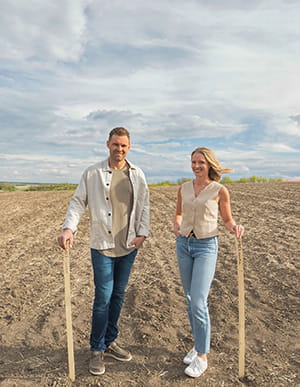
The subsurface drip irrigation lines were installed with a plough behind a tractor. “The subsurface irrigation lines are installed at 11 inches deep and 36 inches apart,” Brady says. “Every line runs continuously from one end of the field to the other.”
One of the bigger limitations would be the higher installation cost, and the inability to grow subsoil crops such as potatoes once the product is installed.
“One of the other options that is available to farmers is to install a fertigation system along with the subsurface irrigation technology,” Brady says. “This system allows you to microdose nitrogen and other nutrients to the root zone as you are watering, which is what we do in our project.”
Changing the Future of Farming
The promise of this technology is immense. For farmers in southwest Saskatchewan, the greatest challenge over the past 20 years has been adequate rainfall. Market volatility, pests and supply chain issues are all part of the business of farming, but subsurface irrigation removes one of the most unpredictable risks.
“With this system, we’ve eliminated dependence on rainfall,” Brady explains. “That changes the game for future producers. It gives us stability and allows us to produce with confidence.”
The project also demonstrates the kind of innovative thinking that keeps Canadian agriculture resilient. By looking to innovations in other countries and adapting these innovations to Saskatchewan agriculture, the Funks are positioning local farmers to thrive in even harsh growing conditions.
Honouring the Past, Building the Future
While innovation fuels their work, Brady and Lindsay remain deeply tied to their roots.
“Our families have farmed or worked in agriculture for four generations,” Lindsay says. “When we stand on a stage receiving an award, it’s not just about us—it’s about honouring the strength of the families who stood behind us and loved agriculture long before we did.”
That sense of legacy motivates them as they look ahead to representing Saskatchewan on the national stage in Toronto this November. More than competition, they see the event as a chance to connect.
“We’re excited to meet nominees from other provinces and build friendships and relationships,” Lindsay says. “It’s about sharing ideas, learning together and celebrating what Canadian agriculture can achieve.”
Brady and Lindsay know that farming will always come with risks. But they also know that with faith to guide them, family to support them, and innovative thinking to push them forward, the future of agriculture in Saskatchewan is in good hands.
“We’re just humbled by the opportunities we’ve been given,” Brady says. “And we hope to use them not only to grow crops, but to encourage others along the way.”
Canada’s Outstanding Young Farmers of 2025 will be chosen during the national competition that will be held in Toronto, Ontario, November 27 to 30, 2025.
For more information on the subsurface drip irrigation system, visit the Braylin Acres website.