
By Augustine Osei, PhD., PAg., Crops Extension Specialist, Weyburn
April 2026
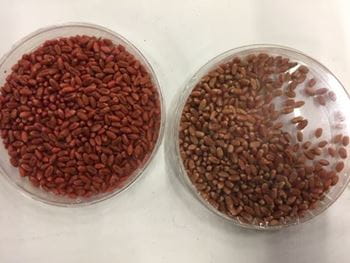
compared with partial or poorly applied seed treatment (right).
Early-season crop vigor and standability play a key role in effective weed management, efficient nutrient uptake and ultimately maximizing yield potential. In prairie production systems, early-season stresses such as cold soil, variable moisture conditions and relatively short growing seasons make uniform crop emergence particularly important. These challenging conditions can expose seeds and seedlings to diseases and insect pests at a vulnerable stage of growth. As a result, seed treatments have become a fundamental component of current crop production systems, as they act as an insurance policy against early-season risks, particularly, from seed- and soil-borne diseases and pests.
What are Seed Treatments?
Seed treatments are chemical, biological or physical substances applied to seeds before planting to protect seeds and seedlings from soil-borne diseases, insects, pathogens and abiotic stress while improving germination and stand establishment.
Benefits and Types of Seed Treatments
The Saskatchewan Guide to Crop Protection provides detailed information on all provincially registered seed treatments for crops grown in Saskatchewan and the protection they offer against different diseases and insects. Seed treatments generally fall into four main categories:
- Fungicidal seed treatments: These seed treatments protect seeds and seedlings from soil-borne fungi and diseases such as Fusarium spp., Pythium spp., Rhizoctonia spp., smuts, etc. Products frequently combine multiple active ingredients from different chemical groups to broaden the spectrum of protection and help manage resistance development.
- Insecticidal seed treatments: These seed treatments protect seedlings from early-season insect pests such as cutworms, flea beetles, wireworms, armyworms and seed corn maggots, which can cause significant damage during early crop development when seedlings are most vulnerable.
- Biologicals and Inoculants: These include microbial products and inoculants that enhance plant growth and nutrient uptake. Examples include rhizobia inoculants which help nitrogen fixation in pulse crops.
- Physical Treatments: This type involves non-chemical approaches such as seed priming to condition seeds for improved germination and emergence. This seed treatment is rarely used in prairie cropping systems.
Considerations in Selecting Seed Treatments
To ensure effectiveness and maximize return on investment, seed treatments should be tailored to the specific threats, soil conditions and crop genetics in the field. Before selecting your seed treatment, ask these fundamental questions:
- What protection will my seed treatment provide?
- Is the product suitable for the environmental conditions on my farm?
- Is the seed treatment (i.e. inoculants) compatible with my crop?
- What is the active ingredient and mode of action in my seed treatment?
- Are my seed-applied pesticides compatible with my biological products or inoculants I plan to use?
What Risk Factors on the Farm Justify the Benefit of Using Seed Treatment?
The following are important field-risk factors to consider when deciding on whether a seed treatment is warranted:
- Field history: Previous crop rotations and historical pest issues play an important role in determining risk. For example, continuous cereal production increases the risk of root rot diseases and wireworms. Similarly, fields previously in pasture have a higher risk of wireworms which will justify the need for seed treatment.
- Growing conditions: Cold, wet soil conditions favor many seedling diseases. In years with cool, wet springs, the economic return from seed treatments is often higher than in warm, dry springs, where disease pressure may be lower.
- Time of seeding: Early seeding increases risk of seed exposure to cold soil which can slow crop emergence, increasing disease risk to seedlings.
- Residue levels: High crop residue can increase pathogen survival and carryover between seasons, elevating disease risk for newly planted crops.
Seed treatments are not a substitute for good agronomic practices such as selecting certified and high-quality, disease-free seeds or considering economic-threshold-based foliar applications when needed. Rather, seed treatment should be used as part of an integrated pest management plan. While it is important that seed treatments are evenly applied to every seed to ensure full and uniform coverage, it is even more important to remember that most seed treatments provide protection only during the early stages of crop development, typically for the first three to four weeks after planting. Hence, aligning seeding timing with this protection window is critical to maximizing the benefit of the treatment.
For more information, contact your local crops extension specialist or the Agriculture Knowledge Centre at 1‑866‑457‑2377.