
It is pretty cool that Saskatchewan is considered a hotspot for fossils around the globe.
The province is unique because the rocks here record the last 30 million years of the Cretaceous period (the time of the dinosaurs). During this time, the area went from being under a shallow continental sea to becoming part of an extensive coastline.
This also includes the last two million years of the Cretaceous period when some of the largest dinosaurs that ever lived roamed the area. Dinosaurs like Tyrannosaurus rex, duckbilled dinosaurs and Triceratops used to call Saskatchewan home.
A prime example is Scotty, the world’s largest T. rex, discovered in the Frenchman River Valley in southwestern Saskatchewan in August of 1991.
Simply put, Saskatchewan has an amazing fossil record!
It is an interesting story, and one of the individuals who gets to help tell it is Wes Long, Collections Manager in Paleontology with the Royal Saskatchewan Museum (RSM).
A Lifelong Fascination
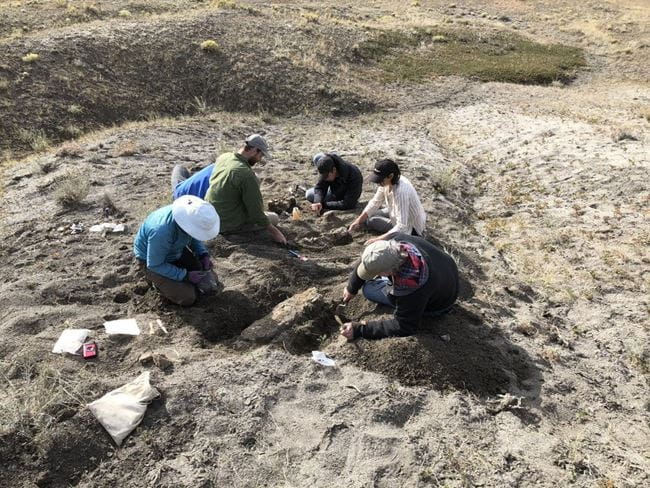
At the RSM, Wes has a very diverse role, spending time in the field collecting fossils, carefully preparing them in the lab and cataloguing them for the RSM’s collection.
“I have been interested in paleontology for as long as I can remember,” Wes explained. “When the opportunity came up to go on a field trip to the Killdeer Badlands back in 1993, I jumped on it. Shortly after, I became a volunteer, which eventually led to a full-time position with the RSM.”
Over his 24-year career, Wes spent 12 years working at the T. rex Discovery Centre in Eastend and the last 12 years in Regina.
Now, looking for fossils can be challenging – it is not as simple as the movies sometimes make it out.
“A typical day of prospecting for fossils includes a lot of hiking and keeping your eyes open, looking for the telltale signs of bone fragments,” Wes explained. “Once you find fragments, you can hopefully trace them up the exposure and discover the source.”
Work at an active dig site can include everything from hill removal, which includes a lot of shovelling, working at the bone layer with fine tools like scalpels and dental picks, plus making a detailed map of the dig site.
The amount of time it takes to excavate and prepare can vary from fossil to fossil.
“Dinosaurs are cool, but I’m mostly interested in marine reptiles, including Mosasaurs, Plesiosaurs and the ever-elusive giant sea turtles,” Wes said.
In 2023, researchers found a large soft-shelled turtle skeleton, from an animal that would have been more than 1.5 metres in length. The soft-shelled turtle fossil is now on display at the RSM.
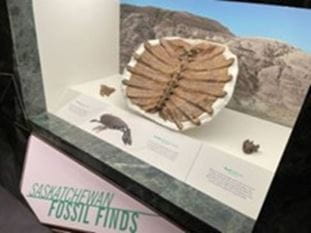
The painstaking work to prepare the fossil was done by Wes, who also worked on preparing the Prognathodon skull from Grasslands National Park in 2021.
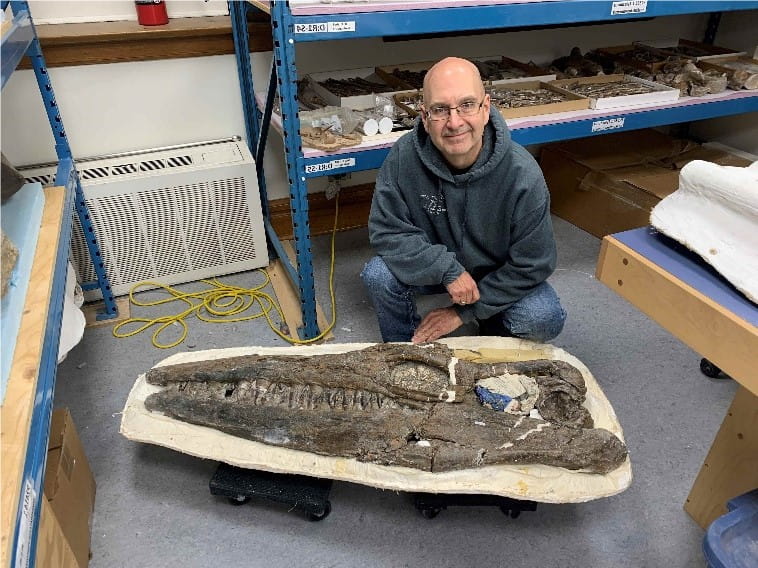
Once a fossil is prepared, it is ready for scientists to study.
Scotty – The World’s Largest T. rex
For the province’s most famous dinosaur, Scotty, the research is still ongoing, as scientists look for insights into these prehistoric animals and the world they lived in.
“A lot of people put in a lot of hard work getting Scotty out of the ground. It was very exciting, but also very challenging,” Wes explained. “We would be in the dig site for the full field season, starting in May and wrapping up in the fall, and it took a total of five field seasons to excavate Scotty.”
The fossilized remains were painstakingly removed, almost completely by hand. Then the hard work began.
Preparing the fossil out of the rock took the equivalent of 20 years of work time.
Some of the original fossil material of Scotty is on display at the Royal Saskatchewan Museum in Regina and at the T. rex Discovery Centre in Eastend.
A Helping Hand – The Benefit of Citizen-Science
Interestingly, some of the province’s most exciting fossil discoveries have been made by the public.
“Scotty was discovered by Robert Gebhardt, a high school principal from Eastend, who accompanied a team of RSM paleontologists’ on a prospecting expedition,” Wes said. “Although he was only there to learn how to find and identify fossils, Gebhardt uncovered a tail vertebra that the museum was able to verify belonged to a T. rex.”
Today, Scotty is a major attraction and one that is near and dear to Wes’s heart.
“Going to the museum and seeing the excitement on kids’ faces when they see Scotty for the very first time – it makes all the years of hard work feel very worthwhile,” he stated.
Rewarding Career
When asked what would surprise most people about the work being done, Wes noted the immense scope of it.
“We have a wide fossil record in our province, which we can be very proud of,” he said. “A lot of people don’t realize that we have dinosaurs in Saskatchewan. And not just dinosaurs; we have marine reptiles and some of the richest fossilized mammal deposits in Canada.”
And when it comes to their work, Wes also heralded the cutting-edge Amber research led by Dr. Ryan McKellar, RSM Curator of Paleontology, and the amazing work that he does.
“Whether it’s a collaboration on research projects or providing access to specimens for visiting researchers and students, the RSM partners with many museums and universities,” Wes said. “This is a wonderful place to work, and it is a privilege to work with so many individuals who are leaders in their respective fields, like Dr. McKeller.”
And helping tell that story is something that Wes loves to do!