A number of pages on the Government of Saskatchewan's website have been professionally translated in French. These translations are identified by a yellow box in the right or left rail that resembles the link below. The home page for French-language content on this site can be found at:
Where an official translation is not available, Google™ Translate can be used. Google™ Translate is a free online language translation service that can translate text and web pages into different languages. Translations are made available to increase access to Government of Saskatchewan content for populations whose first language is not English.
Software-based translations do not approach the fluency of a native speaker or possess the skill of a professional translator. The translation should not be considered exact, and may include incorrect or offensive language. The Government of Saskatchewan does not warrant the accuracy, reliability or timeliness of any information translated by this system. Some files or items cannot be translated, including graphs, photos and other file formats such as portable document formats (PDFs).
Any person or entities that rely on information obtained from the system does so at his or her own risk. Government of Saskatchewan is not responsible for any damage or issues that may possibly result from using translated website content. If you have any questions about Google™ Translate, please visit: Google™ Translate FAQs.
Using Forages for Healthier Farms and Environment
By Leema Mathew, AAg, Agri-environmental Specialist, Kindersley
December 2025
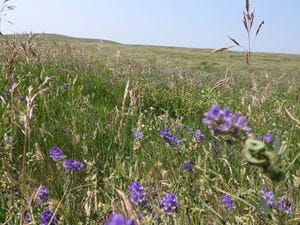
Tame pasture seeded with grass and
legume forage blend
A well-managed forage stand can provide benefits in addition to providing feed for livestock. Forage stands can protect and enhance the soil and store carbon. With the right selection and management, forage stands can deliver significant environmental benefits while maintaining strong productivity.
Converting annual cropland and marginal acres to permanent forage provides continuous ground cover for several years, reducing erosion and improving infiltration. Their deep root system helps to store carbon and build soil structure while minimizing the need for frequent tillage and soil disturbance. This stability makes perennial forages a tool for preventing soil erosion and improving soil health over time. On salinity prone areas, saline tolerant forage species are a good option as they can be productive in these areas where annual crops struggle to thrive.
Diversity in the forage blend can make the forage stand stronger and more resilient. Grasses have a strong root system that holds the soil and adds organic matter. Legumes like alfalfa, sainfoin, clover and cicer milkvetch fix atmospheric nitrogen and improve the soil fertility. A mix of species supports soil microbes and pollinators. Selecting the right forage blend based on soil characteristics, field conditions and the intended purpose will significantly affect the success of forage establishment and growth in the following years.
Rotational grazing is a best management practice when forage is grown for grazing purposes. Moving cattle through several paddocks gives plants time to rest and regrow. This helps maintain healthy roots and stand longevity. Rotational grazing also helps to distribute manure uniformly and prevent nutrient accumulation. Avoiding overgrazing keeps the soil covered and helps forages recover faster.
The Resilient Agricultural Landscapes Program (RALP), funded at a rate of 60 per cent federally and 40 per cent provincially under the Sustainable Canadian Agricultural Partnership, has funding available through the Tame Forage Seeding BMP for seeding the annual crop land to perennial tame forage. Reach out to your local agri-environmental specialist or contact the Agriculture Knowledge Centre at 1-866-457-2377 to explore more details about this program.
We need your feedback to improve saskatchewan.ca. Help us improve