A number of pages on the Government of Saskatchewan's website have been professionally translated in French. These translations are identified by a yellow box in the right or left rail that resembles the link below. The home page for French-language content on this site can be found at:
Where an official translation is not available, Google™ Translate can be used. Google™ Translate is a free online language translation service that can translate text and web pages into different languages. Translations are made available to increase access to Government of Saskatchewan content for populations whose first language is not English.
Software-based translations do not approach the fluency of a native speaker or possess the skill of a professional translator. The translation should not be considered exact, and may include incorrect or offensive language. The Government of Saskatchewan does not warrant the accuracy, reliability or timeliness of any information translated by this system. Some files or items cannot be translated, including graphs, photos and other file formats such as portable document formats (PDFs).
Any person or entities that rely on information obtained from the system does so at his or her own risk. Government of Saskatchewan is not responsible for any damage or issues that may possibly result from using translated website content. If you have any questions about Google™ Translate, please visit: Google™ Translate FAQs.
Technologies for Improved Grazing Management
By Lynnae Ylioja, MSs, AAg, Range Management Extension Specialist, Outlook
November 2025
In the world of ever-advancing technology, where does grazing management fit in? While Saskatchewan farmers and ranchers have embraced rotational grazing, there is an opportunity to go further and take advantage of innovations like water monitoring and virtual fencing to reduce labour and unlock new possibilities.
Remote Water System Monitoring
Research shows that animals prefer to drink out of a trough versus a creek, dugout or slough, and perform better when they do. However, there is risk of livestock being left without water if the system malfunctions or the water bowl freezes. Daily water checks can be time consuming, especially in remote areas. Adding a monitoring system to a source helps mitigate these risks without extra time commitment.
Two Agricultural Demonstration of Practices and Technologies (ADOPT) projects, funded at a rate of 60 per cent federally and 40 per cent provincially under the Sustainable Canadian Agricultural Partnership, have assessed monitoring technologies in Saskatchewan ranching conditions to help overcome some of the limitations of the technology.
In 2017, the Ministry of Agriculture partnered with a local watershed stewardship group to test monitoring systems on a farm in winter and summer. The preferred system used a high-tech trail camera with cell coverage to text a picture of the trough to the producer at regular intervals throughout the day. This gave the producer confidence, allowing convenient water level monitoring right from his phone.
In 2024, there was another trial using the FarmSimple system to monitor both water level and quality. Producers could check water levels anytime on their phones. They liked being able to set their own limits for each parameter, which triggered an alert to their phones when water level or quality was below the pre-set point. The system worked with as little as one bar of cell service, and users could also see on the app if the system was offline. All producers in this trial had confidence in this monitoring system and felt it saved time.
Virtual Fencing
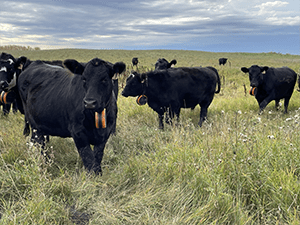
Heifers in a CFGA/DUC virtual fencing
demonstration near Kelliher, Saskatchewan
With a virtual fencing system, livestock wear collars that confine them to an area set from a producer’s cell phone or computer. The virtual fence is moved on the program, and the location is synced to the collar via cell service or satellite. Options exist for using virtual fencing in both good and poor cell coverage areas. Collars are tracked with GPS, and the location of each collared animal is visible in the app or computer program.
When an animal nears the virtual fence, an audible warning will sound from the collar. This is followed by an electric stimulus if the animal continues through the virtual fence. No electric stimulus is received if the animal crosses back in to join the herd. The animals require a short training period (a few days) to learn the system.
Some of the uses for virtual fencing include:
Implementing rotational grazing without physically putting up temporary or permanent cross-fencing.
The ability to graze different types of vegetation separately (such as native vegetation separate from adjacent tame vegetation).\
Targeted grazing of brush, agronomic invasives in native pasture (such as crested wheatgrass) or weeds as a means of non-herbicide control.
Providing alleyways to water for more effective rotational grazing.
Rotational grazing in areas with challenging topography, regular flooding or heavy forest where physical posts and wire are difficult or expensive to use.
To select or sort out specific animals from the herd.
Easier grazing management of crop residues and winter-feeding systems such as corn grazing, swath grazing or bale grazing.
Excluding environmentally sensitive areas without disturbing wildlife or limiting wildlife movement.
Monitoring individual animal movement patterns.
This emerging technology is already widely used in other countries and is now being trialled across the prairies, including through an ongoing Strategic Field Program-funded project in forested pasture using Vence virtual fencing technology. Another project with the Canadian Forage Grassland Association and Ducks Unlimited is trialling Gallagher’s E-Shepherd virtual fencing system, which is now commercially available in Saskatchewan.
Existing and new technologies such as remote water system monitoring and virtual fencing can help rotational grazing become more precise and time efficient. While technology isn’t a replacement for experience and observation, it can help improve our current grazing system management.