A number of pages on the Government of Saskatchewan's website have been professionally translated in French. These translations are identified by a yellow box in the right or left rail that resembles the link below. The home page for French-language content on this site can be found at:
Where an official translation is not available, Google™ Translate can be used. Google™ Translate is a free online language translation service that can translate text and web pages into different languages. Translations are made available to increase access to Government of Saskatchewan content for populations whose first language is not English.
Software-based translations do not approach the fluency of a native speaker or possess the skill of a professional translator. The translation should not be considered exact, and may include incorrect or offensive language. The Government of Saskatchewan does not warrant the accuracy, reliability or timeliness of any information translated by this system. Some files or items cannot be translated, including graphs, photos and other file formats such as portable document formats (PDFs).
Any person or entities that rely on information obtained from the system does so at his or her own risk. Government of Saskatchewan is not responsible for any damage or issues that may possibly result from using translated website content. If you have any questions about Google™ Translate, please visit: Google™ Translate FAQs.
Programs for Grazing Management
By Alanna Jonson, PAg, Agri-Environmental Specialist, Swift Current
November 2025
When it comes to new projects and grazing management plans, winter is a great time to start planning for next year’s grazing season. Reflecting on this year’s grazing season can help identify any areas of improvement in a pasture.
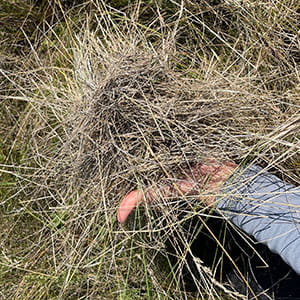
Litter rakes are one component of
grassland health assessments
Through the Resilient Agricultural Landscapes Program (RALP), funded at a rate of 60 per cent federally and 40 per cent provincially under the Sustainable Canadian Agricultural Partnership, producers can receive funding for implementing a variety of different beneficial management practices, or BMPs, on farm. These practices help ensure long-term health and sustainability of agricultural land while minimizing negative impacts and risks to the environment. By using BMPs and incorporating the basic grazing principles into grazing management plans, producers can improve the health and resiliency of Saskatchewan rangelands.
Under RALP there are three different BMPs that use range health assessments to help with grazing management:
The Grazing Management BMP - Native Rangeland Stream
The Grazing Management BMP - Riparian Stream
The Rangeland Health Assessment BMP
For native rangeland, conducting range health assessments or building cross fences are examples of BMPs that can help maintain or improve the pasture’s health and productivity. Setting goals is a good first step before starting any project. Range health assessments can help identify strengths and areas for improvement in the pasture. This is a process that looks at the plants present and the soil to help indicate if a rangeland is functioning its best or in its healthiest state. Range health scores can be used by producers and agrologists to help understand if the current management approach is meeting both short and long-term grazing management goals and where there may be room for improvement. These assessments can be a great tool when designing a grazing management plan or planning for a new cross-fencing project.
The two grazing management BMPs help producers with funding for new cross-fencing projects. These projects can include either temporary or permanent fencing. Pre-approval is required for these BMPs. The ministry’s agri-environmental specialists are a great resource to help provide guidance on which approvals are required for different projects. As some of these approvals can take time, getting started early can help prevent delays next year. Contact the Agriculture Knowledge Centre at 1-866-457-2377 to connect with your local specialist.
A fence might not be the best management choice for every situation. The third program, the Rangeland Health Assessment BMP, is another option to help identify grazing management actions. This BMP is unique because it can be used for health assessments on not only native and forested rangelands but also tame pastures. The program provides funding to hire an agrologist that can complete the assessment and assist in writing the grazing management plan.