A number of pages on the Government of Saskatchewan's website have been professionally translated in French. These translations are identified by a yellow box in the right or left rail that resembles the link below. The home page for French-language content on this site can be found at:
Where an official translation is not available, Google™ Translate can be used. Google™ Translate is a free online language translation service that can translate text and web pages into different languages. Translations are made available to increase access to Government of Saskatchewan content for populations whose first language is not English.
Software-based translations do not approach the fluency of a native speaker or possess the skill of a professional translator. The translation should not be considered exact, and may include incorrect or offensive language. The Government of Saskatchewan does not warrant the accuracy, reliability or timeliness of any information translated by this system. Some files or items cannot be translated, including graphs, photos and other file formats such as portable document formats (PDFs).
Any person or entities that rely on information obtained from the system does so at his or her own risk. Government of Saskatchewan is not responsible for any damage or issues that may possibly result from using translated website content. If you have any questions about Google™ Translate, please visit: Google™ Translate FAQs.
Preventing Weed Seed Spread in the Fall
By Luke Jorgensen, AAg, Range Management Extension Specialist, Weyburn
October 2025
Weeds are never a welcomed sight in your pasture or hayland – they disrupt healthy ecological functions and stress the bottom line of your operation. As the growing season draws to a close, it’s important to remember that weeds can still spread and there are steps you can take to avoid new infestations in the spring.
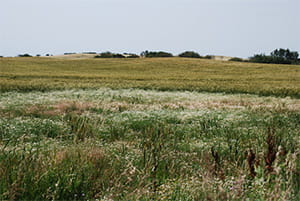
A field with scentless Chamomile weed Infestation
Why It Matters
One of the defining traits of most invasive weeds is prolific seed production. In the fall, weeds such as absinthe or Canada thistle produce thousands of seeds per stem that are ready to disperse, remain dormant over the winter and germinate in the spring.
Anything that spreads weed seeds to new places is called a vector. Common fall vectors for weed seeds include hay, manure, equipment, clothing and livestock. The best way producers can reduce the risk of weed spread is to identify potential weed seed vectors and take steps to mitigate each one.
Vector: Hay
Separate suspect hay from feed you know is weed-free.
Ask suppliers about potential weed contamination before purchasing hay.
Feed suspect or contaminated hay separately and monitor the feeding site in the spring for emerging weeds.
Vector: Equipment and Clothing
Wash or blow off equipment between fields, especially before moving equipment home or between farms. A battery-powered leaf blower is a great weed control investment.
Remind visitors, contractors and staff to maintain weed biosecurity.
Limit unnecessary traffic in pastures and ensure guests understand the risk of spreading weed seeds on tires, boots or gear.
Vector: Livestock
Keep animals penned for a day or two when they return from pasture, especially if you’re not sure of weed presence where they were grazing. Seeds can travel in their gastrointestinal tract or cling to hooves, fur or tails, before dropping in feedyards and starting a new infestation.
The Bottom Line
Few fall management steps can prevent years of costly control work. Talk to your guests about the risk of spreading weeds. Keep equipment and clothing clean and stay aware of what might be coming home in your hay or on your livestock. These simple actions now can protect productive and healthy pastures and hayland for years to come.
We need your feedback to improve saskatchewan.ca. Help us improve