A number of pages on the Government of Saskatchewan's website have been professionally translated in French. These translations are identified by a yellow box in the right or left rail that resembles the link below. The home page for French-language content on this site can be found at:
Where an official translation is not available, Google™ Translate can be used. Google™ Translate is a free online language translation service that can translate text and web pages into different languages. Translations are made available to increase access to Government of Saskatchewan content for populations whose first language is not English.
Software-based translations do not approach the fluency of a native speaker or possess the skill of a professional translator. The translation should not be considered exact, and may include incorrect or offensive language. The Government of Saskatchewan does not warrant the accuracy, reliability or timeliness of any information translated by this system. Some files or items cannot be translated, including graphs, photos and other file formats such as portable document formats (PDFs).
Any person or entities that rely on information obtained from the system does so at his or her own risk. Government of Saskatchewan is not responsible for any damage or issues that may possibly result from using translated website content. If you have any questions about Google™ Translate, please visit: Google™ Translate FAQs.
Fall is a Good Time for Perennial Weed Control in Pastures and Rangelands
By Sheila Taillon, MSc. PAg, Range Management Extension Specialist, Weyburn
September 2025
While spring and early summer remain the best times to control perennial weeds in pasture and rangelands, sometimes spraying at the ideal time doesn’t always work out due to competing priorities or weather challenges. Fall can also be an effective time to apply a selective herbicide, such as picloram, aminopyralid, aminocyclopyrachlor, etc. for control of perennial weed species, especially creeping rooted species. As the days get shorter and temperatures start to cool, perennial species begin transporting nutrients down to their roots for winter storage. Did you know that you can use this winter storage process to your advantage? Selective herbicides applied in the fall will travel with the nutrients into the roots, helping to kill the underground parts of the plants.
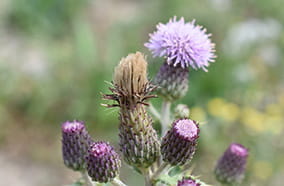
Purple flowers on a Canada thistle in full bloom
4 Key Tips Before Applying a Selective Herbicide in Fall:
Scout first: Locate perennial weed patches and check leaf health. Healthy leaves are needed for the herbicide to be absorbed and move through the plant.
Apply before a light frost: For best results, spray the herbicide before a light frost. If a hard frost hits, wait 24 hours and check the weeds. If the leaves are brown or wilted, skip the application because the herbicide will not be absorbed and will not work. If the leaves are still healthy and temperatures stay above freezing, you’re good to go. Applications are most effective on sunny days when temperatures are above 10 C.
Spot treat: Consider targeted spot treatments rather than broadcast applications to protect legumes in hayland or tame pastures.
Follow label directions: Always read and follow label directions, recommended application rates, and any grazing or other restrictions.
Track your Treatments
When mapping weed locations, it’s helpful to include the following:
Weather conditions including Temperature, wind speed and direction, humidity, sky conditions (sunny, overcast, etc.)
Recording this information can be valuable when monitoring in the spring to see if the treatment was effective.
Use Multiple Control Methods
Remember, while herbicides are a useful tool for perennial weed control, combining two or more methods such as mowing or grazing in combination with herbicides is usually better than relying on one control method alone.
When using herbicides always read and follow label directions and consult the Guide to Crop Protection. For more information on fall perennial weed control in pastures and rangelands contact your local Range Management Extension Specialist or call the Ag Knowledge Centre at 1-866-457-2377.
We need your feedback to improve saskatchewan.ca. Help us improve