A number of pages on the Government of Saskatchewan's website have been professionally translated in French. These translations are identified by a yellow box in the right or left rail that resembles the link below. The home page for French-language content on this site can be found at:
Where an official translation is not available, Google™ Translate can be used. Google™ Translate is a free online language translation service that can translate text and web pages into different languages. Translations are made available to increase access to Government of Saskatchewan content for populations whose first language is not English.
Software-based translations do not approach the fluency of a native speaker or possess the skill of a professional translator. The translation should not be considered exact, and may include incorrect or offensive language. The Government of Saskatchewan does not warrant the accuracy, reliability or timeliness of any information translated by this system. Some files or items cannot be translated, including graphs, photos and other file formats such as portable document formats (PDFs).
Any person or entities that rely on information obtained from the system does so at his or her own risk. Government of Saskatchewan is not responsible for any damage or issues that may possibly result from using translated website content. If you have any questions about Google™ Translate, please visit: Google™ Translate FAQs.
Benefits of Native Prairie
By Austin Baron PAg, Agri-Environmental Specialist, Swift Current
October 2025
Native prairie are an invaluable asset that depend on ranchers and cattle to maintain a healthy range condition. Native grasslands are one of the largest biomes, globally, and are very productive. Much of the land that is native prairie in Saskatchewan is considered to have very low agricultural capability, due to topography and soil texture.
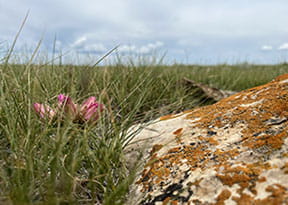
Healthy native prairie contains a variety of
plant species.
The native prairie grasslands offer many cultural, social and ecological benefits, to both public and private interests. These grasslands are home to a very diverse community. The plant communities that make up these grasslands boast a variety of grasses, forbs and shrubs – all of which are important habitat for wildlife. Having diversity in plant species allows for staggered flowering times which provide food sources for pollinators throughout the growing season. These plants are well adapted to the local climate and moisture conditions, making them more resilient to disturbance. Many of the remaining grasslands reside in locations of low agricultural capability, where growing grain crops is unfeasible and would require significant inputs. The plants that grow in the native prairie, however, have specific adaptations that allow them to grow and thrive. These plants combat erosion by holding the soil in place and can use available moisture far more efficiently than non-native species. These acres also provide habitat and allow for greater cycling of nitrogen, carbon and oxygen through the system.
These ecosystems develop under grazing pressure from large ruminants, specifically the vast herds of bison that once roamed the Great Plains. Today, ranching, more specifically grazing cattle, are an integral part of the management of the native grasslands. By looking at multiple aspects of the landscape, including the presence of invasive species, litter layer thickness and plant community, land managers can support and preserve the health of the native prairie. The presence of invasive species can indicate overgrazing or an imbalance in the system. Rangeland managers can also assess range health through the presence of litter (carryover of dead vegetation). Litter provides protection to the soil and helps regulate temperature and evaporative moisture loss. No litter can also indicate overgrazing, whereas excessive litter can indicate under grazing.
Looking at what species and layers of vegetation are present provides a description of present and past health. A healthy system will have a variety of species with multiple layers, which provide various rooting depths. Producers use these range health indicators to determine management practices, such as choosing a stocking rate for the grazing season and the timing of grazing.
Proper grazing and livestock management are crucial to the health of our remaining native prairie. Ranchers have access to educational resources and funding through their local regional office. To get in touch with your regional specialist, please call the Agriculture Knowledge Centre at 1-800-667-4442.
We need your feedback to improve saskatchewan.ca. Help us improve