A number of pages on the Government of Saskatchewan's website have been professionally translated in French. These translations are identified by a yellow box in the right or left rail that resembles the link below. The home page for French-language content on this site can be found at:
Where an official translation is not available, Google™ Translate can be used. Google™ Translate is a free online language translation service that can translate text and web pages into different languages. Translations are made available to increase access to Government of Saskatchewan content for populations whose first language is not English.
Software-based translations do not approach the fluency of a native speaker or possess the skill of a professional translator. The translation should not be considered exact, and may include incorrect or offensive language. The Government of Saskatchewan does not warrant the accuracy, reliability or timeliness of any information translated by this system. Some files or items cannot be translated, including graphs, photos and other file formats such as portable document formats (PDFs).
Any person or entities that rely on information obtained from the system does so at his or her own risk. Government of Saskatchewan is not responsible for any damage or issues that may possibly result from using translated website content. If you have any questions about Google™ Translate, please visit: Google™ Translate FAQs.
Resource Management For Your Winter-Feeding Site
By McKenzie Paget, AAg, Agri-Environmental Specialist, Weyburn, SK
December 2025
Winter feeding is often the greatest expense for a livestock operation. Between buying or putting up feed, hauling bales and keeping animals in good condition, expenses can increase quickly. Careful planning and resource management can stretch your feed supply, save time and protect your pastures for the future.
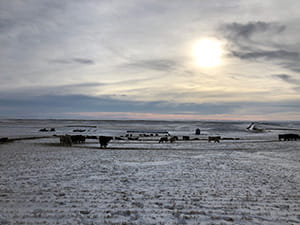
Cattle grazing on a snow-covered field
under a pale winter sun
Know Your Site
Start by figuring out how much feed your herd will need, where you will be wintering and how many head will be on the site. Compare this to what you’ve done previously. What worked well last year and what could be improved this year? Is there space available to move feeding and bedding sites regularly? How far away is your site to where your feed is stored? Is there a water course that runs through the site? These are important considerations when determining your winter-feeding plan and how to best minimize risk and negative impacts on the environment.
Change the Way You Define “Waste”
Bale grazing, swath grazing, corn grazing or shredding bales are all potential winter-feeding options. By using extensive winter-feeding practices, feed residues provide additional nutrients and organic matter to the soil, reducing the amount of commercial fertilizer required for the subsequent crop. While it may seem like you’re wasting feed, it can greatly improve your soil health and improve production in subsequent years.
Save Time and Fuel
Feeding cattle every day burns fuel and hours. Think about whether you can haul and set bales before winter weather arrives or feed larger amounts less often. Grouping bales in rows, investing in a bale processor or setting up sites closer to feed storage areas can all help to reduce labour and equipment wear. These little changes can add to a positive benefit over a long winter.
Manage the Manure
Winter feeding sites are also nutrient sites and can be at risk for nutrient loading and soil compaction. It’s important to rotate where you feed to reduce these risks. Wintering sites are a good management tool to reduce the amount of manure hauled following the winter versus a traditional corral setting, but it’s essential to move feeding areas and shelter each year. The slope of the site is an important consideration when determining appropriate areas to feed. Avoiding low-lying spots or areas near waterbodies to prevent runoff in the spring is recommended.
Following the winter-feeding period, a good option to manage manure is to heavy harrow the site.
Keep an Eye on the Herd
Animal welfare is an important consideration, regardless of season. Ensuring nutritional requirements are being met, livestock have access to water and shelter is provided are critical elements of animal welfare.
The Bottom Line
Budgeting for winter feeding isn’t just about feed – it’s about using your resources, such as time, labour and land, effectively and efficiently. With some planning and a few changes to manage waste and labour, you can keep costs in check, maintain cattle condition, improve the land and set yourself up for a better spring.
We need your feedback to improve saskatchewan.ca. Help us improve