A number of pages on the Government of Saskatchewan's website have been professionally translated in French. These translations are identified by a yellow box in the right or left rail that resembles the link below. The home page for French-language content on this site can be found at:
Where an official translation is not available, Google™ Translate can be used. Google™ Translate is a free online language translation service that can translate text and web pages into different languages. Translations are made available to increase access to Government of Saskatchewan content for populations whose first language is not English.
Software-based translations do not approach the fluency of a native speaker or possess the skill of a professional translator. The translation should not be considered exact, and may include incorrect or offensive language. The Government of Saskatchewan does not warrant the accuracy, reliability or timeliness of any information translated by this system. Some files or items cannot be translated, including graphs, photos and other file formats such as portable document formats (PDFs).
Any person or entities that rely on information obtained from the system does so at his or her own risk. Government of Saskatchewan is not responsible for any damage or issues that may possibly result from using translated website content. If you have any questions about Google™ Translate, please visit: Google™ Translate FAQs.
The Economics of Implementing Extensive-Winter Feeding
By Kaitlyn McMurphy, PAg, Agri-Environmental Specialist, Yorkton
September 2025
As a Saskatchewan livestock producer, the costs associated with wintering animals are likely some of the largest expenses in your operation. Extensive winter feeding has the potential to increase your operation’s profitability by directly decreasing input costs.
Extensive winter feeding is the practice of feeding animals in a large field setting, rather than in corral confinement. It can be adapted to any operation by implementing practices such as bale processing, total mixed rations, corn, bale or swath grazing or delayed grazing of stockpiled forages. The additional time the cows can graze extensively allows for more nutrients from feed waste and excrement to be deposited on the soil. These nutrients not only increase organic matter and improve soil health but also reduce the quantity of synthetic fertilizer required for the next year’s forage or crop production.
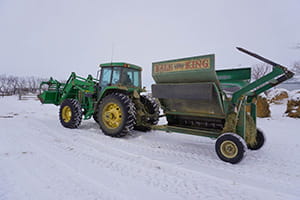
A tractor hauls feed to be shredded on a field in Saskatchewan
Environmental benefits include improved water quality, soil health and rangeland condition, while reducing greenhouse gas emissions and preventing soil erosion. These changes improve the sustainability of the operation in years of drought and inclement growing conditions.
Economic advantages of adopting extensive winter-feeding systems include:
Reduced fuel consumption
Reduced infrastructure requirements
Reduced fertilizer, seed and labour costs.
For a growing operation, extensive winter feeding enables an increase in herd size without the added infrastructure requirement.
Below are a few examples of cost-saving opportunities from implementing an extensive winter-feeding system.
Consider the cost of starting a 100 hp diesel tractor every day, feeding cows in corrals. Assume:
The average cost of diesel is $1.41 per litre (L).
Feeding cows for an hour a day burns 12L per hour.
Cattle are fed from approximately November 1 to May 31 (210 days).
Fuel cost for the winter-feeding period would be $3,553.
In comparison, a bale grazing system would require a tractor for only a few hours at initial set up, costing less than $50 for the duration of the grazing period.
Similarly, savings can be realized on the labour cost to haul feed to the corrals. Assume:
A wage of $23 per hour.
Feeding cows for an hour a day.
Cattle are fed from approximately November 1 to May 31 (210 days).
Labour cost for the winter-feeding period would be $4,830.
In comparison, in a swath-grazing system, approximately four hours are spent every seven days moving the fence. The difference in labour cost between the two systems would be $2,760 — a savings of over $2,000 over the course of the winter. These estimated costs were calculated using the Government of Canada’s Job Bank (2024) for Livestock Farm Labourers in Saskatchewan.
Significant savings can also be captured from nutrient deposition on the landscape. Assume: soil inorganic nitrogen increases by 81 pounds per acre in the spring following swath grazing and the price of urea fertilizer is $830 per tonne.
Approximately $66 per acre could be saved on fertilizer costs.
The cost of urea is based on quotes for the week of September 15, 2025.
It is important to remember that implementing extensive winter feeding in your operation is not an all-or-nothing approach. Extending the time cattle are grazing and out of confinement can make an economic and environmental impact.
If you are interested in implementing an extensive wintering site on your operation, funding is available through the Sustainable Canadian Agricultural Partnership Extensive Wintering Site Management BMP with funding covering 60 per cent of eligible costs. For more information on funding, please contact the Ag Knowledge Centre at 1-866-457-2377.
We need your feedback to improve saskatchewan.ca. Help us improve