A number of pages on the Government of Saskatchewan's website have been professionally translated in French. These translations are identified by a yellow box in the right or left rail that resembles the link below. The home page for French-language content on this site can be found at:
Where an official translation is not available, Google™ Translate can be used. Google™ Translate is a free online language translation service that can translate text and web pages into different languages. Translations are made available to increase access to Government of Saskatchewan content for populations whose first language is not English.
Software-based translations do not approach the fluency of a native speaker or possess the skill of a professional translator. The translation should not be considered exact, and may include incorrect or offensive language. The Government of Saskatchewan does not warrant the accuracy, reliability or timeliness of any information translated by this system. Some files or items cannot be translated, including graphs, photos and other file formats such as portable document formats (PDFs).
Any person or entities that rely on information obtained from the system does so at his or her own risk. Government of Saskatchewan is not responsible for any damage or issues that may possibly result from using translated website content. If you have any questions about Google™ Translate, please visit: Google™ Translate FAQs.
Learning a Different Way: The Peer Group Pilot Project
Alexis DeCorby, PAg, Livestock and Feed Extension Specialist
November 2025
As extension specialists, part of our job is to facilitate learning for producers. Often, this takes shape through one-on-one conversations, events and demonstration projects. While these methods work well, we recently decided to try a new approach: Producer peer groups.
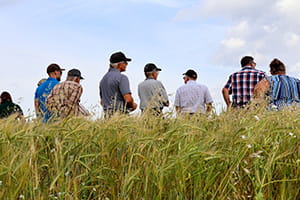
Producers in a field
While peer groups are not a new concept, in the age of technology, these peer groups can now be done in a new way. A team of specialists, led by Natasha Wilkie, Livestock and Feed Extension Specialist, Fonda Froats, Provincial Cattle Specialist and Kathy Larson from the University of Saskatchewan, along with funding and support from the Beef Cattle Research Council, developed a pilot project to test out these producer peer groups.
Through this pilot, producers were identified through Kathy’s work with the Canadian Cow-Calf Cost of Production Network. The ones who were interested were split into groups of six to eight. Group meetings were held via Zoom and Teams every two months, with two in-person meeting opportunities provided throughout the duration of the pilot. The goal was to give producers an opportunity to learn from one another and facilitate learning sessions that they deemed to be of interest.
The Beef Cattle Research Council funding guest speakers and in-person events so the producer groups could learn about a wide range of topics including managing stress, farm taxation and management, cattle markets and CanFax information.
Through the process, a group chat was created for producers to stay connected outside of scheduled meetings. Though not frequently used, the group chat provided an additional channel for them to stay connected and share experiences on their operations.
Upon completion of the pilot project, producers were asked to complete a survey to capture their experiences. All producers that responded to the survey indicated they were somewhat or very likely to recommend peer groups to their fellow producers. Additionally, all respondents voted to extend the peer group pilot project.
Producers identified discussions between producers about operational differences as the most valuable part of the peer groups. They indicated this time provided them with opportunities to get new ideas, learn about problems and solutions and gather information that would benefit their operation.
Being part of a peer group is a unique opportunity to connect with producers across the province to share advice and access learning opportunities tailored to their interests. Due to success with the peer group pilot project, a second iteration of peer groups is currently under development. These groups are open to mixed or livestock producers who are under the age of 35. The structure of these groups will be similar to the previous model, with the key difference that fewer virtual meetings (three to four per year) will be held. Instead, producers will be placed in a group chat with prompts provided throughout each month. Producers will be invited to share their own experiences and advice based on the prompt and will also be able to ask questions at any time.
Interested in joining a peer group and learning from your fellow producers? There are still openings available. If you’re interested in joining, please contact your local livestock and feed extension specialist or contact the Agriculture Knowledge Centre at 1‑866‑457‑2377.
We need your feedback to improve saskatchewan.ca. Help us improve