A number of pages on the Government of Saskatchewan's website have been professionally translated in French. These translations are identified by a yellow box in the right or left rail that resembles the link below. The home page for French-language content on this site can be found at:
Where an official translation is not available, Google™ Translate can be used. Google™ Translate is a free online language translation service that can translate text and web pages into different languages. Translations are made available to increase access to Government of Saskatchewan content for populations whose first language is not English.
Software-based translations do not approach the fluency of a native speaker or possess the skill of a professional translator. The translation should not be considered exact, and may include incorrect or offensive language. The Government of Saskatchewan does not warrant the accuracy, reliability or timeliness of any information translated by this system. Some files or items cannot be translated, including graphs, photos and other file formats such as portable document formats (PDFs).
Any person or entities that rely on information obtained from the system does so at his or her own risk. Government of Saskatchewan is not responsible for any damage or issues that may possibly result from using translated website content. If you have any questions about Google™ Translate, please visit: Google™ Translate FAQs.
Testing Hay for Horses
By Chelsey Siemens MSc., P.Ag., Livestock and Feed Extension Specialist, Kindersley
September 2025
Evaluating the quality of hay for horses can be complicated as the appearance doesn’t always correspond to its quality. A feed analysis provides valuable information on the nutrients in hay which can be compared to a horse’s nutritional requirements to determine if the feed will meet those needs.
To get the best estimate of forage quality, start by collecting a representative sample. Here are some things to keep in mind when collecting a sample:
If the hay has all come from the same area and was harvested and baled at the same time, it can be considered one lot.
Sample at least 10 per cent of bales from each lot of hay to get a sample that best represents what will be consumed on a daily basis.
It is best to use a forage probe to collect core samples from multiple bales.
Sample round bales from the round side so the probe collects hay through each wrap of the bale.
Small or large square bales should be probed from the end.
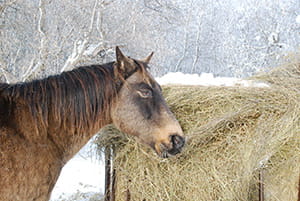
A horse feeds on hay in winter
Once a representative sample of approximately 200 grams has been collected, it can be placed in a large resealable bag and sent to a feed testing laboratory for analysis. Some labs offer a specific forage analysis for horses, which will include the energy content of the feed expressed as Equine Digestible Energy in megacalories per kilogram (Mcal/kg), and may include Ethanol Soluble Carbohydrates (ESC) and starch, which are useful analyses for horses with insulin resistance or those that are prone to laminitis.
In many cases, it is not necessary to order an equine-specific analysis. A general forage test for cattle will contain most of the information necessary to assess hay quality. The digestible energy, or total digestible nutrients (TDN) calculated for cattle can be converted to digestible energy for horses. These energy values differ because horses are approximately 10 to 15 per cent less efficient at digesting fibre than cattle are.
A forage analysis will also include a measure of crude protein (CP) and minerals including calcium, phosphorus, magnesium and potassium. Microminerals like selenium are not usually included in a general forage analysis, but most labs have optional analyses that can be added to the basic test.
When reading a feed test, there are usually two columns — one labelled "as fed" and the other "dry matter". Use the dry matter column to evaluate forage quality since most nutrition resources list animal requirements on a dry matter basis. Compare the nutrient requirements for the age, stage and activity level of the horse(s) to be fed against the nutrient content of the feed. If there is a shortfall of any nutrient, another feed ingredient may need to be added to the diet to address the difference between what is required and what is supplied by the forage.
Livestock and feed extension specialists can provide advice on which analysis to choose and can help to interpret feed test results. Forage probes are available to borrow from your nearest regional office. For more information, contact your nearest livestock and feed extension specialist by calling the Agriculture Knowledge Centre at 1-866-457-2377.
We need your feedback to improve saskatchewan.ca. Help us improve