A number of pages on the Government of Saskatchewan's website have been professionally translated in French. These translations are identified by a yellow box in the right or left rail that resembles the link below. The home page for French-language content on this site can be found at:
Where an official translation is not available, Google™ Translate can be used. Google™ Translate is a free online language translation service that can translate text and web pages into different languages. Translations are made available to increase access to Government of Saskatchewan content for populations whose first language is not English.
Software-based translations do not approach the fluency of a native speaker or possess the skill of a professional translator. The translation should not be considered exact, and may include incorrect or offensive language. The Government of Saskatchewan does not warrant the accuracy, reliability or timeliness of any information translated by this system. Some files or items cannot be translated, including graphs, photos and other file formats such as portable document formats (PDFs).
Any person or entities that rely on information obtained from the system does so at his or her own risk. Government of Saskatchewan is not responsible for any damage or issues that may possibly result from using translated website content. If you have any questions about Google™ Translate, please visit: Google™ Translate FAQs.
Navigating Livestock Transportation Requirements
By Corissa Wilcox, PAg, Livestock and Feed Extension Specialist, Swift Current
October 2025
With the fall run in full swing, it’s a busy time of year for livestock producers. While regulations may not always be top of mind, it’s important to be aware that The Animal Production Act and The Animal Production Regulations govern livestock inspection and transportation requirements within the province. Ensuring the correct documentation is in place supports compliance and facilitates smooth, safe and traceable livestock transportation.
Provincial documentation is required for transporting livestock species (cattle, bison, horses, goats, sheep and swine) as outlined in the legislation, in the form of livestock manifests or inspection certificates. Livestock Services of Saskatchewan (LSS) has been delegated the authority to provide livestock manifests and inspection services for cattle and horses in Saskatchewan. Livestock inspection verifies ownership through examination of the animals, brands or other identifiers and any other relevant documentation. Inspection certificates can be issued following livestock inspection and are required for certain situations.
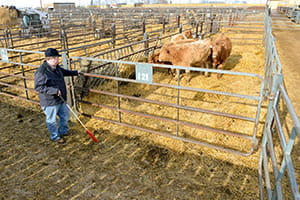
Cattle handling facility
Below are some examples to help clarify which documents (livestock manifest vs inspection certificate) are required for different transportation scenarios. These examples have limited detail and this is not a comprehensive list of transportation scenarios nor are they a substitution for the legislation. Contact LSS to discuss your specific scenario and required documentation.
Scenario 1: Livestock are being transported to an exhibition show in Saskatchewan where they will be entered into a sale event.
A livestock manifest is required because the animals are being transported, the event involves comingling of animals and a sale. In this scenario, cattle and horses would be inspected prior to sale as well.
A valid inspection certificate can be used instead of a livestock manifest for cattle or horses if the animals were inspected prior to transport.
Scenario 2: A load of calves from a Saskatchewan auction mart is being transported to an Alberta feedlot following a sale.
A livestock manifest is required, as the destination is an inspection site (as defined in the Livestock Identification and Commerce Act, Alberta) located out of province and the calves will be inspected upon arrival.
A valid inspection certificate can be used instead of a livestock manifest if the cattle were inspected prior to transport.
Scenario 3: A livestock producer is transporting their cattle from a pasture that they own, lease or rent in Saskatchewan to their winter feeding site.
A livestock manifest or inspection certificate is not required, as the producer is transporting animals between owned or fully controlled properties within Saskatchewan and the animals are not intermingled with those belonging to another owner.
If livestock are intermingled with other animals, such as in a grazing association pasture, a livestock manifest would be required.
Scenario 4: Horses are being transported for recreational use, to 4-H events and rodeos within Saskatchewan.
A livestock manifest is required, as the transportation event involves comingling of animals.
A valid inspection certificate can be used instead of a livestock manifest.
Federal requirements also exist for transporting livestock into, within and out of Canada under Health of Animals Regulations. A transfer of care document is a federal requirement to ensure the humane transport of animals to and from assembly centres or slaughter facilities. Ensuring animals are fit for transport and having a contingency plan when travelling are also included in this legislation.
MyLivestock is a multispecies livestock transportation tool that aims to comply with provincial and federal transportation requirements.
For more information regarding livestock inspection and transportation requirements, contact Livestock Services of Saskatchewan at 306-546-5086. For more information on federal requirements for transporting livestock, visit, the Government of Canada website.
We need your feedback to improve saskatchewan.ca. Help us improve