A number of pages on the Government of Saskatchewan's website have been professionally translated in French. These translations are identified by a yellow box in the right or left rail that resembles the link below. The home page for French-language content on this site can be found at:
Where an official translation is not available, Google™ Translate can be used. Google™ Translate is a free online language translation service that can translate text and web pages into different languages. Translations are made available to increase access to Government of Saskatchewan content for populations whose first language is not English.
Software-based translations do not approach the fluency of a native speaker or possess the skill of a professional translator. The translation should not be considered exact, and may include incorrect or offensive language. The Government of Saskatchewan does not warrant the accuracy, reliability or timeliness of any information translated by this system. Some files or items cannot be translated, including graphs, photos and other file formats such as portable document formats (PDFs).
Any person or entities that rely on information obtained from the system does so at his or her own risk. Government of Saskatchewan is not responsible for any damage or issues that may possibly result from using translated website content. If you have any questions about Google™ Translate, please visit: Google™ Translate FAQs.
Feed Production Economics
By Dwayne Summach, PAg, Livestock and Feed Extension Specialist, Outlook
October 2025
Preserving feed efficiently for winter use can be done in many ways, each affecting overall profitability. Options include stockpiling grass during the growing season for dormant-season grazing, baling hay or greenfeed or making silage.
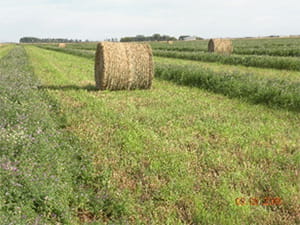
Second cut alfalfa
The cost to make stored feed is dependent on several factors. The capital investment in feed making equipment can have a substantial range – older equipment can be used but the risk of a critical component breaking during the harvest window can result in substantial quality loss. Newer equipment may be less prone to breakdowns, but the increased capital investment contributes to increased depreciation costs. No matter the equipment, harvest efficiency will affect the cost structure. Harvest efficiency is heavily influenced by yield – higher yielding crops result in lower cost per ton of feed.
One cost that remains constant, regardless of yield, will be the cost of transporting the feed. Every bale or every ton of silage will be moved from where it is produced to where it will be stored prior to feeding. Costs can add up when transporting feed a significant distance, so the shortest possible distance is ideal. This can be achieved when the feed is stored and fed in the field where it was grown.
Loading costs are minimized when bales are left grouped together in a field using an accumulator – this method requires additional equipment investment. Selecting a mode of transport that minimizes additional equipment and labour may also lower transportation costs. Self-loading and unloading bale trailers do not require an extra tractor to load in the field, though they may not carry as many bales as a semi-truck and flat deck trailer unit.
According to the 2024-25 Custom Rate and Rental Guide, the cost to cut and condition a hay crop is usually between $19 and $28 per acre. The cost to roll up a 5’ x 6’ round bale is $15 to $19 per bale, and transportation costs will likely fall in between $3.75 to $6.50 per bale depending on the equipment used and distance.
Assigning appropriate equipment costs to feed production is a significant component of determining feed costs on a livestock operation. For additional information on calculating feed production costs contact your local livestock and feed extension specialist or the Agriculture Knowledge Centre at 1-866-457-2377.