
By Hillary Luchinski, PAg, Forage Extension Specialist, Tisdale
December 2025
Forage acres are the foundation for maintaining and building our livestock industry's national and international competitiveness. They also play a role in expanding crop rotations to break disease cycles and manage soil and nutrient challenges. Some of these benefits include:
- greater long-term economic stability;
- higher grain yields following forages;
- shifts in weed populations away from cropland weeds;
- wildlife habitat;
- carbon sequestration; and
- the addition of significant amounts of nitrogen.
Establishing and terminating perennial forage crops can seem daunting to those more familiar with growing annual cash crops. Rising land prices and shrinking commodity margins often make the three to five years the forage is in the rotation seem impractical. However, research and economic analysis show that forages can be profitable and the yield benefits can be seen for several years after the stand is terminated. Research has shown that pure alfalfa stands can add up to 150 lbs/ac of nitrogen into the soil. Incorporating perennial legumes, such as alfalfa, can benefit subsequent crops for up to eight years after it is terminated.
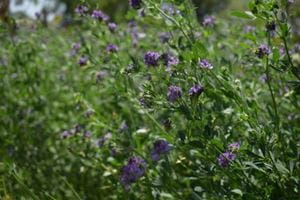
Economically, adding forages into rotations makes sense. While not as lucrative as a cash crop such as canola or wheat, there is still profit to be made. This is partially because the seeding and input costs, such as fertilizer and pre-seeding weed control, are amortized over the stand lifetime. When income from the resulting hay or silage is factored in, forages show a respectable profit and low risk of crop failure. Research by Jefferey et al. (1993) indicates that pure alfalfa stands terminated after four or five years showed the greatest economic efficiency in a rotation.
Diversifying crop rotations with perennial forages can also be an effective tool to interrupt pest and disease cycles. However, the benefits depend heavily on the species included in the forage blend, the target pest or disease and the environmental conditions of the growing season. For example, including forages in annual crop rotations is a great option to control clubroot but may not reduce the persistence of Aphanomyces spp. (pulse root rot) since some forage legumes are host plants for the spores. Similarly, including forages in rotation to interrupt grasshopper life cycles depends on the type of grasshopper and the species of grass and/or legume included in the forage blend.
Using and marketing the forage can be a challenge for many annual crop producers. Often, they do not have the harvest equipment or the animals to use it. Many livestock producers are happy to have additional feed sources, especially during drought, and may be open to cutting, baling and hauling the forage themselves. Growing perennial forages for seed production is another option to consider. In the Saskatchewan Forage Seed Development Commission 2024 annual report, the commission reported that Saskatchewan alone reported forage seed deliveries worth approximately $14.8 million in the 2023-24 fiscal year.
Forages can be an effective tool for extending rotations, managing soil nutrients and interrupting pest and disease cycles while turning a tidy profit with low input costs. To learn more about forage establishment, management and economics, reach out to your local range management extension specialist or call the Agriculture Knowledge Centre at 1-866-457-2377.