
By Joseph Maciag, Communications Consultant – Multimedia, Communications Branch, Regina
While other kids were inside playing video games and surfing the web during the COVID-19 pandemic, Abbey Norek was out working on the farm with her dad—and that’s when she grew a deep appreciation for agriculture.
“I’ve always had an appreciation for it, but that’s when I kind of learned what an incredible, amazing industry it is. It just grew into my obsession from there,” says Norek.
Farming has been integral to her family for generations. Norek explains that her family has been farming in the Gerald area since the 1930s, when two families—the Noreks and the Lomendas—joined together to create Norenda AG, a multi-generational grain farm that prides itself on being progressive while building on traditions from the past.
Norek has been busy working multiple jobs with her family’s operation. “Through the summer, I work on the farm, labouring and working on construction projects like the expansion in our vineyard. Come September and October, I run a combine that I share with my brother,” she explains.
“I also help manage grain deliveries because Norenda has a storage facility for the Louis Dreyfus Company based in Yorkton.”
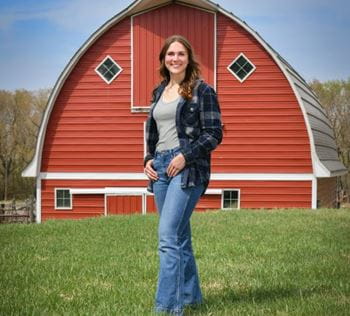
grand prize recipient
Hard work and perseverance are cornerstones of the Norenda AG operation, and that rings true when it comes to Norek. She’s the grand-prize winner of the 2025 Agriculture Student Scholarship, receiving a $6,000 scholarship to undertake post-secondary education at the University of Saskatchewan, where she will be pursuing her Bachelor of Science in Agribusiness.
For this year’s scholarship application, students were given the choice of creating either a three-minute video or writing an essay on the theme of solutions to challenges in agriculture. Applicants were graded on their alignment with the theme as well as their leadership potential.
Norek’s winning video highlighted the risks of an aging farming population and the urban-rural disconnect when it comes to agriculture. She proposed education and advocacy as key solutions to these issues. Demonstrating strong personal commitment to this topic, she discussed her experience building a school garden using recycled materials, leading outreach programs on her family farm, and lobbying for agriculture electives in her school division.
As the groundskeeper for her high school and elementary school in Esterhazy, one day while mowing she noticed that there was a lot of land that was being underutilized around the area. “I was thinking about how much wasted space there is, and I was talking about it with my mom and dad,” Norek says. “That’s when we came up with the idea to start a garden because we figured there’s lots of kids in town that could benefit.”
She believes that with a little hands-on experience through gardening, other kids in her community will grow to have a passion for agriculture like she does.
“I felt by helping to give other students the opportunity to have hands-on experience like I did, they’ll have a deeper appreciation for growing and learning about where their food comes from.”
On top of this, Norek was selected as a student representative from her high school for the Student Summit in the Good Spirit School Division. The summit brings together students who have demonstrated leadership qualities to act as representatives to discuss issues arising in their schools.
“As a committee we met in January of this year and were discussing what students were interested in for electives. So we did a survey, and lots of kids brought good feedback about agriculture classes,” says Norek. “There’s so many careers and opportunities in agriculture and I want to bring more awareness to them, and that’s why I’m passionate about [advocating for] this agriculture class.”
By providing students with agricultural opportunities in her community through both hands-on learning and advocating for more in-class learning, she’s working to build public trust in agriculture and inspire the next generation to see its innovation and career potential.
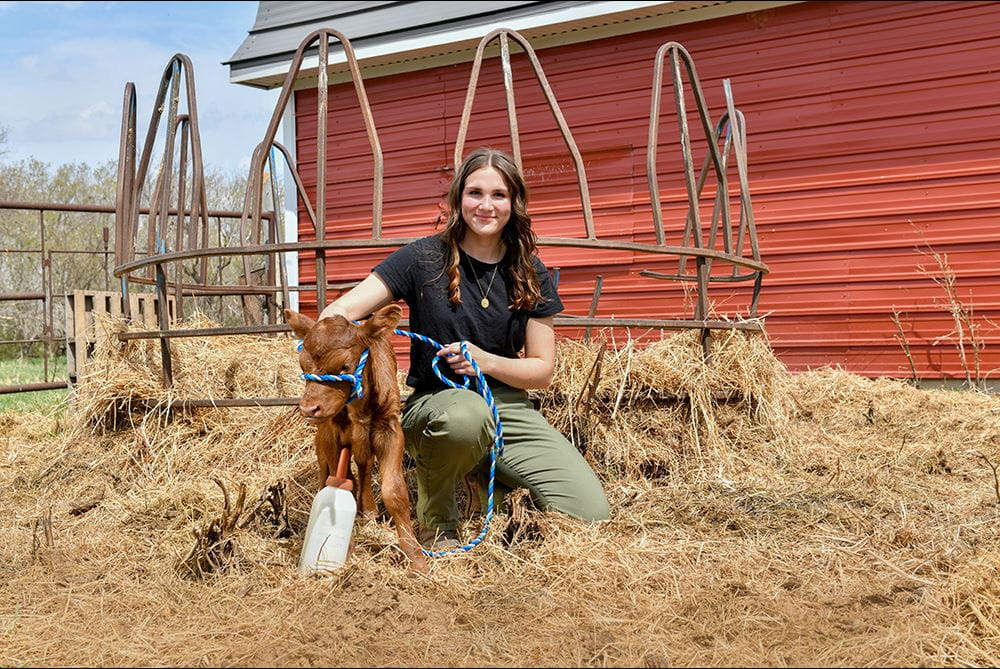
Norek finds the sheer amount of variety that comes with agriculture throughout Canada inspiring. “Every single province is so diverse and different,” she says.
“Agriculture from coast to coast is just so exciting … you go from B.C. where they have orchards, to P.E.I. where they’re having potato farms, and then all the way in between there’s the bread baskets and every type of livestock you can imagine. My dream is to make a difference in farming across the country.”
Would she recommend that others apply for the Agriculture Student Scholarship? “Absolutely, 1,000 per cent!” exclaims Norek. “Trying to get more young people involved in spreading awareness about agriculture and improving public perception is important.”
The Agriculture Student Scholarship is funded through the Sustainable Canadian Agricultural Partnership, a five-year, $3.5-billion investment by Canada's federal, provincial and territorial governments that supports Canada's agri-food and agri-products sectors.;
This year’s Agriculture Student Scholarship Runners-up
In addition to the $6,000 grand prize scholarship, three recipients were awarded $3,000 each to further their agricultural knowledge at a post-secondary institution.
Noah Skoropad
In his compelling video, Noah Skoropad addressed the challenge of feeding a growing global population, spotlighting Saskatchewan farmers as a key part of the solution. While critics and media sometimes frame agriculture as environmentally harmful, Noah cited research showing its potential to combat climate issues through sustainable practices. He advocated for integrating agricultural education into schools to highlight how Saskatchewan farmers are adapting and leading in sustainability.
Rebecca Mayerle
Rebecca Mayerle wrote a thoughtful essay on the power of education in reshaping public perceptions of sustainable agriculture. She demonstrated leadership by interviewing a producer and emphasizing the importance of giving farmers a stronger voice in telling their story. She also advocated for education through social media, blogs and farm tours, and championed organizations like Agriculture in the Classroom to help foster public trust in the industry.
Ty Annand
Ty Annand’s resourceful essay tackled the pressing issues of global food security, land degradation and labour shortages. He advocated for precision agriculture technologies—such as variable rate applications, pulse width modulation and autonomous equipment—as solutions that boost efficiency and yields while minimizing environmental impact. His essay underscores the importance of applying innovation to face some of agriculture’s biggest challenges.