
Northern Saskatchewan Environmental Quality Committee
Since 1995, the Government of Saskatchewan has partnered with the Northern Saskatchewan Environmental Quality Committee (NSEQC) to make sure northern voices are heard in decisions about uranium mining and other developments that affect the land, water and people of the north.
Northern Saskatchewan has some of the largest high-grade uranium deposits in the world and supplies a significant share of the global uranium used for electrical generation. The NSEQC provides a trusted forum where northern residents can learn about industry activities, ask questions, share traditional knowledge and offer recommendations to government regulators and mining companies.
A Voice for the North
The NSEQC was established in 1995 following recommendations from the Joint Federal-Provincial Panel on Uranium Mining Developments in Northern Saskatchewan. The panel called for stronger local participation in decisions about uranium projects. In response, three regional Environmental Quality Committees were created then merged in 2000 into a single Committee (the NSEQC) with co-chairs from each region.
“The Northern Saskatchewan Environmental Quality Committee gives northerners a strong voice in decisions that affect their communities, land and livelihoods,” Minister Responsible for First Nations, Métis and Northern Affairs Eric Schmalz said. “The Government of Saskatchewan is committed to supporting the committee to keep trust, share information and ensure northern perspectives are reflected in decisions about uranium development.”
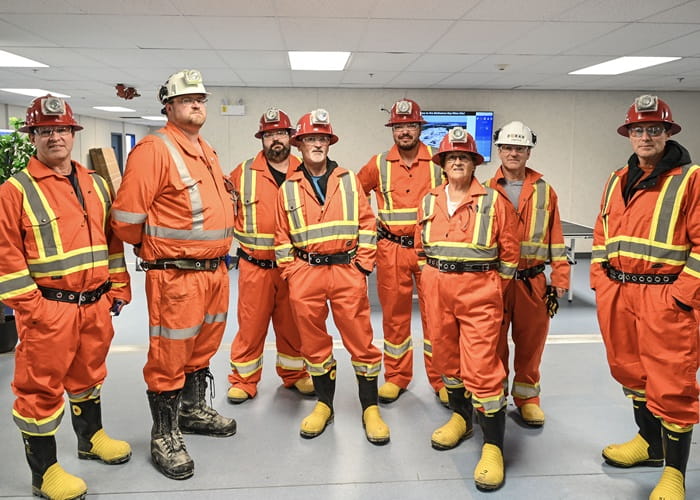
mine while it is under construction 60 km west of Creighton
The NSEQC is one of the largest standing public-involvement committees in Canada. The committee’s members are nominated by community leaders from across the Northern Saskatchewan Administration District. Each community may nominate a primary representative and an alternate. Today, 22 primary and four alternate members serve on the NSEQC and more than 429 northerners, most of them Indigenous, have represented their communities since 1995.
A Forum for Information and Local Perspectives
The NSEQC is an advisory committee, not a regulator. It does not license mines, operate facilities or set policy. Its strength lies in sharing information and building relationships among northern communities, uranium companies and regulators.
“All of the parties benefit from the dialogue,” said Scott Boyes, Director of Northern Engagement responsible for the NSEQC. “Northern residents learn about and visit resource developments and industry and government alike get early northern perspectives on how projects are managed.”
Through this partnership, NSEQC representatives share information in their home communities about uranium mining and milling, environmental protection, worker and public health and safety, transportation of ore and materials and local socio-economic opportunities. They bring forward questions, concerns and ideas from community members to industry officials and government regulators and participate in learning opportunities such as mine and mill tours, workshops and technical presentations, including visits to operating and decommissioned sites.
NSEQC members also provide northern perspectives during environmental assessments and Canadian Nuclear Safety Commission licensing hearings. When requested, they respond to other northern developments that may have environmental impacts such as gold mining, forestry, power line maintenance or peat moss harvesting while keeping uranium related issues as the committee’s top priority.
By offering a table for all of northern Saskatchewan instead of focusing only on communities closest to individual projects, the NSEQC helps ensure that northerners across the region can follow developments and see firsthand the measures used to protect the environment and worker health and safety.
Government and Industry Support Behind the Scenes
The Ministry of Government Relations manages and funds NSEQC. A manager and administrative staff based in La Ronge organize meetings and tours, secure presenters, support committee members with travel and logistics, and help develop written and verbal submissions for environmental assessments and licensing hearings.
The uranium industry supports the committee by providing in-kind assistance such as flights to remote mine and mill sites, access to technical and scientific staff and opportunities for workshops, information sessions and site tours. Each company’s Mineral Surface Lease Agreement requires communication with the NSEQC, reinforcing the role of the committee as a primary partner in engagement with northern communities.
Results for Northern Communities
Over nearly 30 years, the NSEQC partnership has helped build trust and strong relationships between industry, regulators and northern communities through regular meetings, clear information and direct dialogue. It has increased understanding of how workers and the environment are protected and monitored at mine and mill sites, including tailings management and decommissioning activities, and provided a comfortable space for northerners to share views, traditional knowledge and local experience, knowing their questions will be heard and answered.
The partnership has also strengthened regulatory decisions by ensuring provincial and federal regulators routinely consider northern perspectives when reviewing licences, approvals and environmental assessments, and has offered a model of engagement now studied by other jurisdictions in Canada and internationally as an example of effective community involvement in major resource developments.
As new topics arise such as the work of the Nuclear Waste Management Organization, information is shared at the NSEQC table so representatives can help distinguish between uranium mining and nuclear waste storage when talking with their communities.
Looking Ahead
As the NSEQC approaches its 30th anniversary, the Government of Saskatchewan remains committed to supporting the committee through renewed mandates, dedicated staff and ongoing operational funding. Alongside other provincial and federal partners and the uranium industry, the committee will continue to support informed, honest conversations about development in the north.
While its mandate has broadened modestly over time, its purpose remains the same: to connect people, share information openly and ensure decisions about northern Saskatchewan’s resources are guided by those who live there.