
Released on March 3, 2026
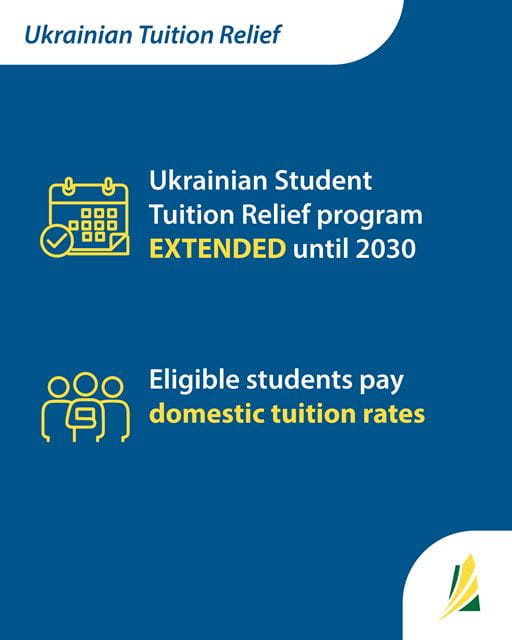
Ukrainian post-secondary students in Saskatchewan will continue to receive tuition relief from the Government of Saskatchewan until March 31, 2030.
The extension allows those who arrived under the Canada-Ukraine Authorization for Emergency Travel (CUAET) program to continue paying domestic tuition rates instead of international rates at post-secondary institutions in the province. Saskatchewan is the only province in Canada that offers this level of support.
"Since launching this program in 2023, we have seen firsthand how tuition relief can transform the futures of Ukrainian students who came here seeking refuge from war," Advanced Education Minister Ken Cheveldayoff said. "Extending this support to 2030 ensures learners have the stability, opportunity and encouragement they need to complete their education and potentially contribute to Saskatchewan's future."
Ukrainians who came to Canada under the federally regulated CUAET program are typically considered international students and face higher tuition rates when applying to post-secondary programs.
"The Ukrainian Canadian Congress of Saskatchewan is pleased to learn of the provincial government's decision to extend its tuition relief program for Ukrainian students who came to Saskatchewan under the CUAET program," Ukrainian Canadian Congress of Saskatchewan President Elena Krueger said. "Allowing displaced Ukrainians to pay domestic rather than international tuition fees will have a lasting impact on the lives of young people navigating extraordinary challenges as a result of Russia's war on Ukraine. Investing in educational support ensures that displaced Ukrainian students can meet their potential and contribute meaningfully to society, both here in Saskatchewan and, one day, in Ukraine's recovery. We look forward to a continued partnership and dialogue between the provincial government and Saskatchewan's Ukrainian community."
Individuals registered with CUAET will be eligible for tuition relief immediately. Eligible students will pay domestic tuition rates until March 31, 2030. The Government of Saskatchewan will conduct a program review in 2029 to determine whether the need for tuition relief remains.
"When I arrived in Saskatchewan as a high school student, I hoped to continue my education here, but paying international tuition would have made that impossible for my family," University of Regina student Anton Merzliakov said. "The tuition relief program made university possible for me, and extending this support gives me confidence that I can complete my degree and continue building my future here."
Over 35 students have benefited from the Ukrainian Tuition Relief Program since its launch.
For more information on eligibility and to apply, visit: www.saskatchewan.ca/residents/saskatchewan-supports-ukraine/ukrainian-student-tuition.
-30-
For more information, contact: