
Released on September 18, 2025
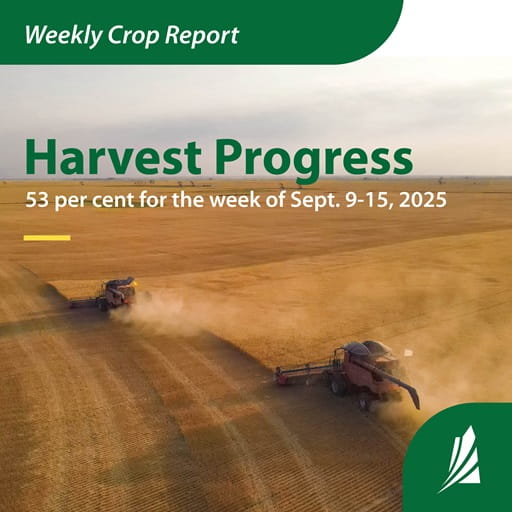
Many areas of the province received rainfall this past week causing producers to briefly pause harvest. Harvest is currently 53 per cent complete, which is a 12 per cent increase from last week. The five-year harvest progress average for this period is 73 per cent, while the 10-year average is 62 per cent. Despite the rain slowing progress, it is welcomed by producers in dry areas as it will improve soil moisture conditions.
The southwest region is the furthest along with 66 per cent of crops harvested. The southeast region currently has 58 per cent of the crop in the bin. Harvest is at the same stage in the west-central and northwest regions as 47 per cent of crops have been combined. The east-central region is currently at 46 per cent complete while the northeast has 42 per cent in the bin.
Winter wheat and fall rye harvest is now complete. Field pea and lentil crops are very close to wrapping up at 96 and 91 per cent respectively. Triticale is at 75 per cent harvested. Leading spring-seeded cereals, 72 per cent of barley acres have been harvested. Other spring cereals are also coming along as 66 per cent of durum, 56 per cent of spring wheat, 52 per cent of oats and 20 per cent of canary seed have been harvested. Chickpea combining is progressing slowly with 27 per cent harvested. For oilseed crops, mustard leads harvest progress at 41 per cent. Many producers are beginning to harvest canola with 21 per cent in the bin. Flax and soybeans are the least advanced in harvest progress, with six per cent of flax and 13 per cent of soybeans currently harvested.
Crop yield and quality vary throughout the province due to the fluctuation of rainfall received throughout the growing season. Pea grades are mainly 2 Canada (CAN) at 53 per cent with 42 per cent at 1 CAN; this is very similar to the 10-year average of 51 per cent 2 CAN and 42 per cent 1 CAN. Lentil grades are mainly 2 CAN at 60 per cent with 26 per cent at 1 CAN; the 10-year average is 51 per cent 2 CAN and 31 per cent 1 CAN. Durum grade quality is reported at 23 per cent 1 Canada Wheat (CW), 43 per cent 2 CW and 23 per cent 3 CW. The 10-year average for durum grade quality is 38 per cent 1 CW, 29 per cent 2 CW and 19 per cent 3 CW. Quality for barley is reported at 24 per cent malt, 68 per cent 1 CW and eight per cent 2 CW per sample. The 10-year average for barley is reported at 31 per cent malt, 50 per cent 1 CW and 19 per cent 2 CW per sample.
There was significant rainfall in some areas of the province during this reporting period. The Kipling area received the most rainfall this past week with 100 mm. The Lampman and Aberdeen areas closely followed with 85 mm and 81 mm of precipitation, respectively. Other areas to receive notable rainfall include the Churchbridge area with 78 mm, the Griffin area with 77 mm, the Glenavon area at 75 mm and the Rouleau area with 74 mm.
The precipitation this past week has improved topsoil moisture conditions for most areas of the province. Topsoil moisture conditions for cropland are rated as six per cent surplus, 66 per cent adequate, 22 per cent short and six per cent very short. For hayland, topsoil moisture is six per cent surplus, 58 per cent adequate, 25 per cent short and 11 per cent very short. Finally, pasture topsoil moisture is three per cent surplus, 54 per cent adequate, 29 per cent short and 14 per cent very short. After harvest has wrapped up, producers are hoping for lots of rain to restore depleted soil moisture reserves.
Wind, wildlife and waterfowl were the main causes of crop damage this week. Frost on later seeded crops and hail were also reported to be causing damage. Grasshopper activity remains high in some areas, continuing to damage crops.
Producers are still working hard to swath and combine crops. As we move into the later stages of harvest, more producers will be focused on post-harvest weed control, storing grain and hauling bales.
With most producers still busy with harvest, safety should always be a priority in all the work they do. Fire risks are still present when working in fields despite the recent moisture, so it's important to not get complacent. Producers should also be aware of powerlines when transporting heavy equipment. The public is reminded to be patient and exercise extra caution when meeting or passing farm machinery on public roads.
A complete, printable version of the Crop Report is available online.
Follow the 2025 Crop Report on Twitter at @SKAgriculture.
-30-
For more information, contact:
Kim Stonehouse
Agriculture
Tisdale
Phone: 306-878-8807
Email: kim.stonehouse@gov.sk.ca