
Wage Assessments and Appeals
If Employment Standards finds that wages are owed to an employee under The Saskatchewan Employment Act, an employment standards officer will issue an inspection report. This report will detail the calculation of wages owed and directs the employer to either provide more information or pay the amount owed.
If the employer does not comply, Employment Standards will issue a wage assessment, which is a legal order to pay wages. A wage assessment can been issued against the employer, corporate directors or both.
The employee as well as the employer or corporate director may appeal the wage assessment.
If the wage assessment is not paid following the appeal period, or if the wage assessment amount is upheld at an appeal, an administrative fee will be applied to the amount of the wage assessment. The administrative fee is 10 per cent of the amount of the wages owed from a minimum of $100 to a maximum of $500.
While there are no administrative costs to appeal a wage assessment, the employer or corporate director must provide a deposit of the wage assessment amount, up to a maximum of $1,000, to be eligible to appeal.
Along with the notice of appeal, the deposit must be received by Employment Standards from the person appealing the wage assessment within 15 business days of the service of the wage assessment. Cheque or cash deposits may be received at any Employment Standards office. Appeal deposits by cheque from an account with insufficient funds will be considered not received on time, resulting in the appellant being ineligible to successfully appeal the wage assessment.
An employee appealing a wage assessment is not required to provide a deposit.
There are special rules about appealing a wage assessment issued as part of a decision that a discriminatory action was taken for a prohibited reason.
1. Overview
An appeal is a challenge to a wage assessment decision by an investigating officer who administers and enforces The Saskatchewan Employment Act. Employment Standards appeals can be filed by employers or employees.
2. Eligibility
Employees and employers are both eligible to appeal if they do not agree with the amount of wages determined to be owing in a wage assessment.
Either party has 15 business days after the wage assessment has been served to make an appeal.
3. Appeal Process
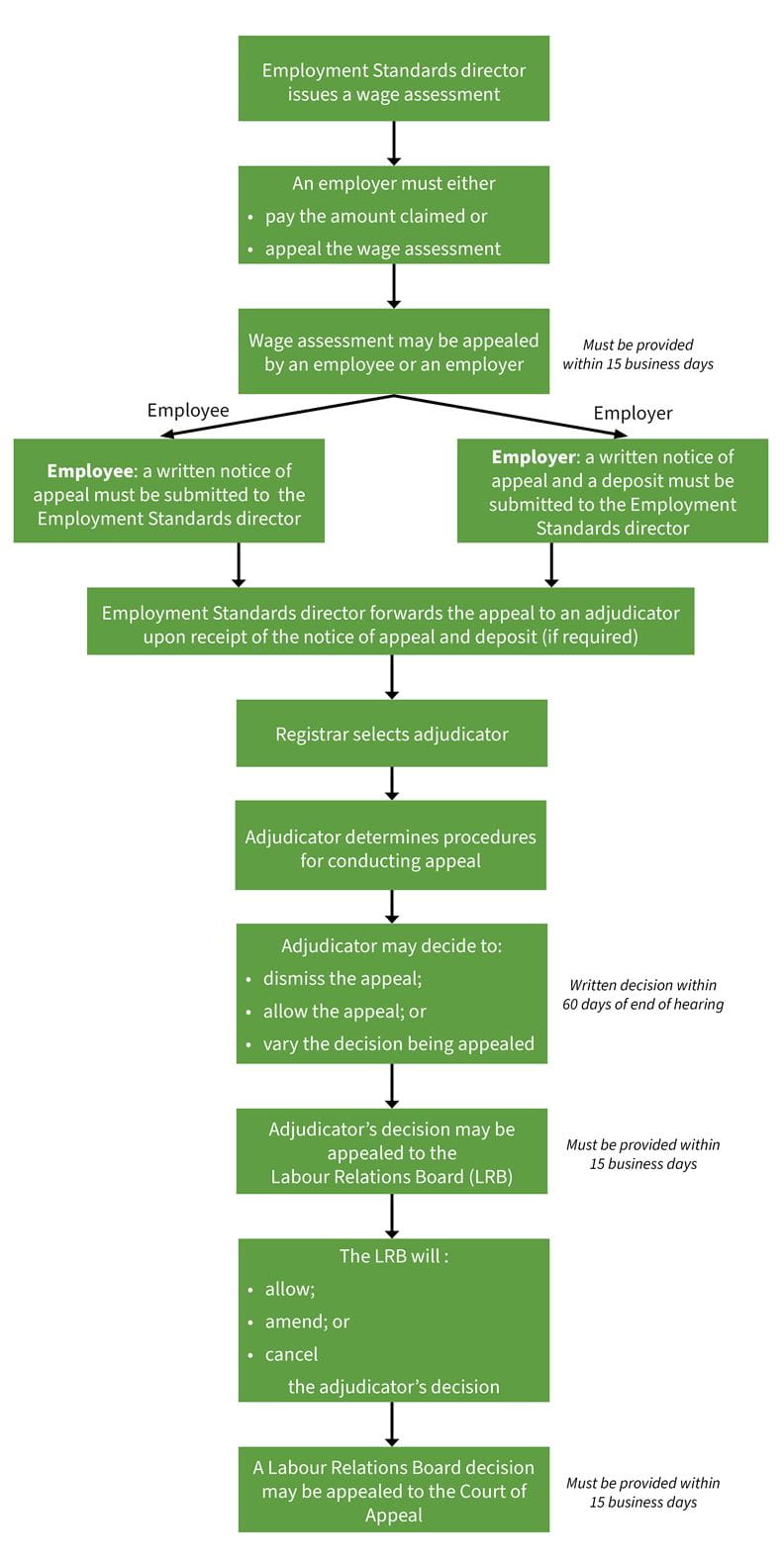
Appealing the Director's Decision to an Adjudicator
Once Employment Standards is provided the notice of appeal and the deposit (if applicable), the registrar of the Labour Relations Board (the Board) is informed that an appeal has been filed. The registrar is responsible for:
- selecting an adjudicator; and
- consulting with the adjudicator and the parties involved to set:
- a time;
- a date; and
- a place for the hearing.
Once notified that an adjudicator has been selected, the director will forward copies of the wage assessment and the written notice of the appeal to the adjudicator.
If Employment Standards is served an appeal and appeal deposit (even the correct amount) outside of the 15 business day time limit in the legislation, the adjudicator may decide that they lack the jurisdiction to hear the appeal. In these cases, if the adjudicator decides that the wage assessment was not appealed correctly by law, the wage assessment remains in effect, and the wages may be recovered.
Adjudicators
Adjudicators are independent of Employment Standards and are responsible for hearing all evidence and arguments from each party. They determine how a hearing will be conducted. They are not bound by the normal rules of evidence, meaning they may accept any evidence they consider appropriate.
Hearings
Hearings are a new consideration of the matter by the adjudicator. The appellant must present their case and information to the adjudicator as if it had not been heard before by the investigating officer. Appellants may represent themselves or have a lawyer or another person act on their behalf at a hearing. The parties to the appeal are not required to be physically present at a hearing and can attend by phone or video if allowed by the adjudicator. Appellants may be required to present additional relevant documents, provide testimony or testify during a hearing.
Adjudicator's Decision
Following the hearing, the adjudicator can decide to accept, dismiss the appeal or vary the amount of the wage assessment.
The adjudicator must provide written reasons for the decision to the Board, Employment Standards, and any employees, the employer and liable corporate director within 60 days of the end of the hearing. If a decision is not received after 60 days, Employment Standards may contact the adjudicator by letter to request their decision. If the 60-day timeline is passed and a decision has not been made, the Board can compel the adjudicator to produce a decision. If for any reason the adjudicator does not provide a decision, the Board can appoint a new adjudicator.
Appealing the Adjudicator's Decision to the Labour Relations Board
If the employee, employer or liable corporate director does not agree with the adjudicator's decision, they may appeal on a question of law with the Board within 15 business days of receiving the decision. A question of law is about the correct legal test. Appeals generally can not be reheard on the facts.
If Employment Standards does not agree with the adjudicator's decision, they can provide a notice of appeal with the Board within 30 business days of the date the decision was served. An appeal to the Board by Employment Standards can be based on a question of law or a question of mixed law and fact. Mixed law and fact means whether the facts meet the legal tests.
The appellant is required to provide copies of the notice of appeal to the same parties involved in the appeal to the adjudicator. The appellant is also responsible for providing case documents (known as a record of appeal) which consists of:
- the wage assessment or notice of hearing;
- the notice of appeal;
- any documents filed with the adjudicator during the hearing;
- the written decision of the adjudicator;
- the notice of appeal to the Board; and
- any other documents required by the Board.
Once the Board reviews the notice of appeal and record of appeal, it has the authority to affirm, amend or cancel the adjudicator's decision. They can also send the decision back to the adjudicator for amendment. Once an appeal is submitted to the Board, the adjudicator's decision is still in effect, unless the Board orders otherwise.
Appealing the Board's Decision to the Court of Appeal
A request for leave to appeal of the Board's decision on a question of law can be made to the Court of Appeal by the employee, employer, corporate director or director of Employment Standards within 15 business days of receiving the Board's decision. The rules of the Court of Appeal apply.
4. How to Submit
An appeal must be provided in writing to the Employment Standards by courier, registered or regular mail, email or fax. The notice of appeal must state:
- The reason for the appeal; and
- How the situation should be corrected.
An employer’s appeal must also include a deposit equal to the amount of the wage assessment up to a maximum of $1,000.
If the wage assessment is upheld on appeal, the deposit will be automatically applied to the outstanding wage claim. If the wage assessment is fully or partially overturned, the money will be refunded to the employer.
Employees who disagree with the amount of the wage assessment can also submit a written appeal to Employment Standards. The employee is not required to provide an appeal deposit in these instances.
5. Submit
Appeal notices can be made in person or by ordinary or registered mail, courier, fax or e-mail.
Appeals are accepted at any Employment Standards office. It is recommended you contact our call centre at 1-800-667-1783 for office operating hours.
If appealing by mail, using a courier, certified or registered mail will help ensure that the appeal is delivered within the 15-business-day limit and provide a record of delivery.
E-mail appeals can be sent to the e-mail address on the wage assessment or to employmentstandards@gov.sk.ca and are considered received on the next business day after they are sent.
Please know that to be eligible to appeal, the appeal notice and deposit must be received by Employment Standards within the 15-business-day time limit. Otherwise, an adjudicator may find that the appeal did not meet the legislative requirements, in which case they do not have jurisdiction to hear the appeal. If so, the wage assessment will be upheld.
6. Withdrawing an Appeal
An employer, employer, or corporate director may withdraw their appeal by serving a written notice to:
- employment standards;
- the other parties to the appeal; and
- the adjudicator, if one has been selected.
The withdrawal must be served before the date of the hearing.
7. Further Information
Refer to Part IV of The Saskatchewan Employment Act to learn more about the legislation regulating appeals under the Act.
The Labour Relations Board is an independent, quasi-judicial tribunal, responsible for hearing appeals of adjudicator decisions involving employment standards matters (Part II) of The Saskatchewan Employment Act.
The Court of Appeal reviews decisions made by the Court of King's Bench, Provincial Court and certain tribunals, such as the Labour Relations Board, to determine if the judge or tribunal or adjudicator made material errors. The court of appeal may dismiss the appeal, allow the appeal and order a new trial or hearing, or allow the appeal and change the order of the lower court or tribunal.