
Children only come into care as a last resort if they are unsafe at home. Those in need of protection may be experiencing complex issues such as physical or sexual violence, or a parent experiencing an addiction or mental health crisis.
If a child is found to be in need of protection, we first look at supports we can connect the family with for the child to remain safely at home. These supports may include services and tools on parenting, counselling, interpersonal violence prevention and addictions treatment. At any given time, around 3,000 children live safely at home with their families while they receive ongoing child protection services. When a child does have to come into care, our goal then becomes reunification.
We have strived to strengthen the system to improve outcomes for children in care by addressing these critical areas:
- Collaborating with Indigenous and community partners to provide prevention services that keep children safe and connected with their cultures, families and communities.
- Engaging with youth in care to ensure their perspective on programs and services is integrated.
- Investing in services that:
- provide intensive support services to keep at-risk families together;
- improve supports for children and youth within community-based care;
- provide enhanced services to youth who are transitioning out of care or have recently transitioned from care; and,
- strengthen support for family-based caregivers.
Provincial Child Welfare Statistics - 4th Quarter
The total number of children in out-of-home care statistics are divided into two streams:
- Children in Care: this number includes those children who are wards (considered to be in care of the Minister), those with apprehended status and those under voluntary agreement.
- Person of Sufficient Interest (PSI) Legal Status: this number includes children who are not in care but are placed by court order in the custody of a trusted family connection, such as a family member, close friend, Band, etc. PSIs are sometimes referred to as non-wards.
Over the past six years, the number of children entering care has remained at or below average levels. There have been increases in the overall number of children and youth in out-of-home care as there were more children entering care than there were exiting. This suggests that children remain in care longer than in previous years. This may be, in part, attributed to families presenting with much more complex challenges, including an influx of families struggling with misuse of substances, which may delay or interfere with family reunification.
| Point in Time | Children in Care1 | PSIs (Legal Status)2 |
| Mar 31, 2020 | 3,362 | 2,080 |
| Mar 31, 2021 | 3,687 | 2,177 |
| Mar 31, 2022 | 3,531 | 2,188 |
| Mar 31, 2023 | 3,814 | 2,097 |
| Mar 31, 2024 | 3,916 | 1,981 |
| Mar 31, 2025 | 4,064 | 1,867 |
| Mar 31, 2026 | 4,148 | 1,734 |
1 This number includes wards and those children with apprehended status and children in care under a Voluntary Section 9 Agreement, a Section 56 Extension of Services and wards of another province (where the ministry is providing courtesy supervision).
2 This number includes children/youth who are placed by court order in the custody of a designated Person of Sufficient Interest caregiver.
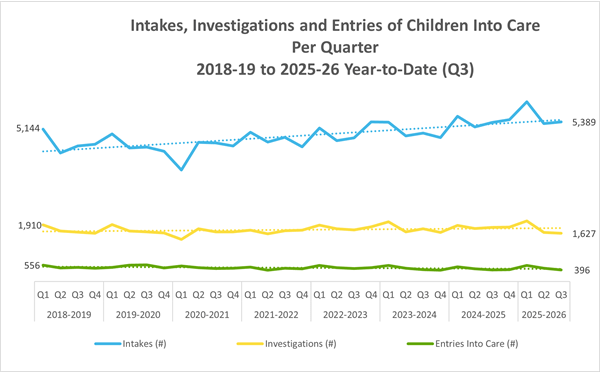
NOTE: As updated information becomes available, data may be revised. As such, numbers may differ from previous reports or at the time of next report.
1 Fiscal years starting April 1st. Q1 is April to June, Q2 is July to September, Q3 is October to December, and Q4 is January to March.
2 The methodology for reporting changed in Q4 2023-24 to the total number of entries into care occurring within each reporting period. A child may have more than one entry into care within a quarter (i.e.: if they were brought into care, were reunified, and then brought into care again within the quarter).
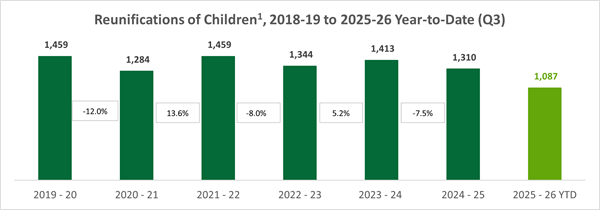
NOTE: As updated information becomes available, data may be revised. As such, numbers may differ from previous reports or at the time of next report.
NOTE: Approximately 80% of discharges are reunifications (range of 75.4% to 86.9% per fiscal year, between 2018-2019 and 2025-2026).
1 Fiscal years starting April 1st. Q1 is April to June, Q2 is July to September, Q3 is October to December, and Q4 is January to March.
2 The methodology for reporting changed in Q4 2023-24 to the total number of reunifications occurring within each reporting period. A child may have more than one reunification within a fiscal year (i.e.: if they were reunified, brought back into care and then reunified again within the fiscal year).
Placement Types
The ministry prioritizes family-based care as the best option for children and youth who cannot remain safely at home. Every effort is made to first place children with extended family, whenever possible, to help keep them connected to their family, culture and community. Seventy-two per cent (72%) of children in out-of-home care live in family-based care, with 55% living with extended family and 17% living in foster homes. As of March 31, 2026, there were 450 approved foster homes in the province.
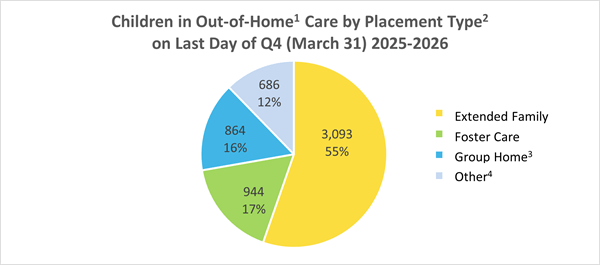
1 Children in Out-of-Home Care includes children in care and non-wards.
2 Counts and proportions of placement types do not include children who have been transferred to a First Nations Child and Family Services Agency.
3 Group Home placement types include: CFS CBO Group Home, CLD CBO Group Home, CLD Approved Service Home, First Nations Approved Group Home, MSS Fee for Service Contract, and Stabilization Care Linkin placement services.
4 “Other” placement types include: Not Indicated, Absent from Care, Addiction Treatment Facility, Rehabilitation Facility, Courtesy Interprovincial, First Nation Approved Caregiver – No Transfer, Hospital, Independent Living, Non-Removal Parent, Out of Province Care, Room & Board, Trial Home Placement, Unauthorized Living Arrangement and Young Offender Facility.
Indigenous Children in Out-of-Home Care
We recognize Saskatchewan’s long and painful history of residential schools and the ‘60s Scoop, and the impact these policies have had on Indigenous families.
The percentage of children and youth in out-of-home care in Saskatchewan who are Indigenous is disproportionately high – as is the case across Canada.
This is a very complex situation, and there are many reasons why we are seeing a disproportionately large number of Indigenous children coming into care despite the significant strides we have made with our partners to strengthen and support vulnerable families experiencing crisis.
One of the main reasons why we have seen an increase in the numbers of children and youth in care identified as Indigenous comes from our efforts over the past few years to ensure Indigenous children and youth are identified as such. Properly identifying children in care who are eligible for Indigenous registration ensures they receive appropriate cultural support and are connected to their communities, bands, and to First Nations Child and Family Services agencies.
The work to renew the child welfare system will continue with our First Nations, Métis and Inuit partners, so Indigenous children and families will be supported by their communities, within their own customs and cultural traditions.
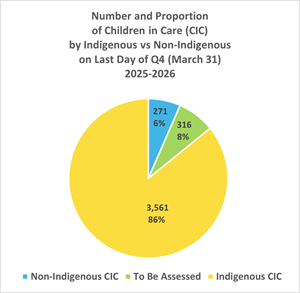
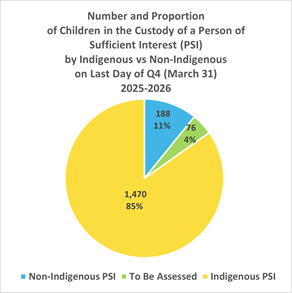
NOTE: For children listed as ‘To Be Assessed,’ a review to determine whether they are Indigenous or Non-Indigenous has yet to be completed.
| Point-in-Time | Indigenous Children in Care | Indigenous PSIs (Legal Status) | ||
| # | % | # | % | |
| Mar 31, 2020 | 2,878 | 86% | 1,841 | 89% |
| Mar 31, 2021 |
2,967 | 80% | 1,935 | 89% |
| Mar 31, 2022 |
2,838 | 80% | 1,927 | 88% |
| Mar 31, 2023 |
3,091 | 81% | 1,830 | 87% |
| Mar 31, 2024 |
3,190 | 81% | 1,711 | 86% |
| Mar 31, 2025 | 3,296 | 81% | 1,599 | 86% |
| Mar 31, 2026 | 3,561 | 86% | 1,470 | 85% |
Critical Injuries and Deaths
In the past several years, we have had a number of children and youth either in care, or who have received services within 12 months, experience either a critical injury or pass away each year.
We conduct a thorough review when a child who was in our care, in receipt of services, or was in receipt of services within the previous 12 months from our ministry or a First Nations Child and Family Services agency experiences a critical injury or passes away.
- We complete these reviews as a mechanism of continuous improvement to determine if the death or injury could have been prevented and aiding us in improving our policies, practices, and training.
- These internal reviews are shared with the Advocate for Child and Youth and the Coroner’s Service.
Our staff work closely with youth, their families, caregivers and other support services to ensure appropriate follow up is in place following a critical injury or death.
| Fiscal Year | Critical Injuries1 | Child Deaths1 |
| 2019-20 | 15 | 35 |
| 2020-21 | 11 | 35 |
| 2021-22 | 7 | 27 |
| 2022-23 | 5 | 42 |
| 2023-24 | 8 | 39 |
| 2024-25 | 13 | 27 |
| 2025-26 | 7 | 28 |
1The statistics for child deaths and critical incidents/injuries are reflective of children/youth who were in the care of the Minister 12 months prior to the occurrence, and children/youth in receipt of services pursuant to The Child and Family Services Act at the time of the occurrence or in the 12 months prior to the occurrence.