
Released on September 17, 2018
With two years of data proving drivers reduce their speed on photo speed enforced roads, and that the number and severity of collisions and injuries on those roads go down as a result, the Government of Saskatchewan has decided the photo speed enforcement (PSE) program will continue on a permanent basis.The results of the PSE pilot show that the number of speeding drivers has gone down in both high-speed locations and school zones, resulting in fewer collisions and injuries.
“Our government is committed to making Saskatchewan roads safer, and photo speed enforcement is an important tool in achieving that,” Minister Responsible for SGI Joe Hargrave said. “Excessive speed is one of the leading causes of death and injury on Saskatchewan roads.”
In 2016, there were 22 fatalities and 579 injuries in speed-related crashes in Saskatchewan. In 2017, speed was a factor in collisions that resulted in 11 deaths and 582 injuries. An evaluation of the PSE pilot shows an average of 28 fewer collisions resulting in casualties in the clearly marked high-speed PSE areas per year. This meant an estimated 40 fewer injuries per year.
The program achieved its target of less than one per cent of drivers violating the speed limit, on average, at the high-speed locations. At school zone locations, the number of collisions resulting in casualties dropped by seven per year, leading to an estimated 10 fewer injuries per year.
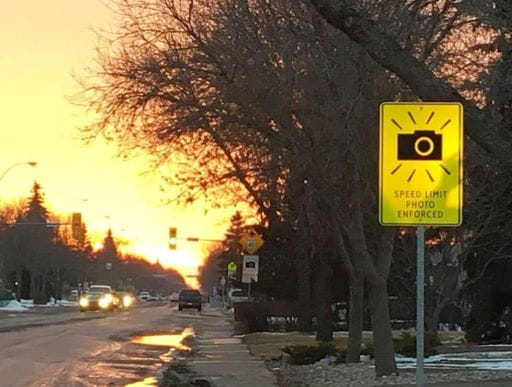
The decision to continue with PSE allows consideration of using it at additional sites. A new committee will decide what high-risk areas around the province could benefit from photo speed enforcement. The committee will include representatives from: government, SGI, RCMP, municipal police, the Saskatchewan Urban Municipalities Association, the Saskatchewan Association of Rural Municipalities and the Federation of Sovereign Indigenous Nations.
As occurred with the pilot, any new location will have prominent and permanent signs to ensure drivers are aware they are approaching a PSE location. There will be a pre-determined warning period in any new site before tickets are issued.
The committee will also oversee allocation of money from a new Provincial Traffic Safety Fund, made up of revenue from PSE tickets. Communities throughout the province will be able to apply to the fund for traffic safety improvements, even if there is no photo speed enforcement in their community.
“Frankly, we’d be happier if there were zero speeding tickets and zero revenue,” Hargrave said, “People who obey speed limits don’t get speeding tickets. If someone chooses to drive faster than the legal limit in areas where signs clearly indicate photo speed enforcement is taking place, their fines will support additional traffic safety initiatives.”
Effective January 1, 2019, ticket revenue from PSE will be allocated as follows:
As occurred with the pilot, any new location will have prominent and permanent signs to ensure drivers are aware they are approaching a PSE location. There will be a pre-determined warning period in any new site before tickets are issued.
The committee will also oversee allocation of money from a new Provincial Traffic Safety Fund, made up of revenue from PSE tickets. Communities throughout the province will be able to apply to the fund for traffic safety improvements, even if there is no photo speed enforcement in their community.
“Frankly, we’d be happier if there were zero speeding tickets and zero revenue,” Hargrave said, “People who obey speed limits don’t get speeding tickets. If someone chooses to drive faster than the legal limit in areas where signs clearly indicate photo speed enforcement is taking place, their fines will support additional traffic safety initiatives.”
Effective January 1, 2019, ticket revenue from PSE will be allocated as follows:
- Highway locations – 25 per cent of ticket revenue goes to the General Revenue Fund (GRF); remaining 75 per cent goes to the Provincial Traffic Safety Fund, minus amount needed to recoup program expenses.
- Municipal locations – 25 per cent of ticket revenue goes to the GRF; remaining 75 per cent will be split 50/50 between a Provincial Traffic Safety Fund and the municipality to be invested in traffic safety initiatives, minus amount needed to recoup program expenses. Eligible traffic safety initiatives could include traffic calming measures, traffic signal upgrades or pedestrian crossings.
A report outlining detailed results of the photo speed enforcement pilot is available on SGI’s website at www.sgi.sk.ca.
-30-
For more information, contact:
Tyler McMurchy
Saskatchewan Government Insurance
Regina
Phone: 306-751-1837
Email: tmcmurchy@sgi.sk.ca
Cell: 306-535-6207