
Investments into the ECE Workforce
Early childhood educators (ECE) provide developmentally appropriate care and learning programs for children and support parents and caregivers to participate in the economy or upgrade their skills.
The province recognizes that ECEs are important to growing the number of regulated child care spaces in the province and has prioritized investments into the recruitment and retention of ECE professionals under the Canada-Saskatchewan Canada-Wide Early Learning and Child Care Agreement.
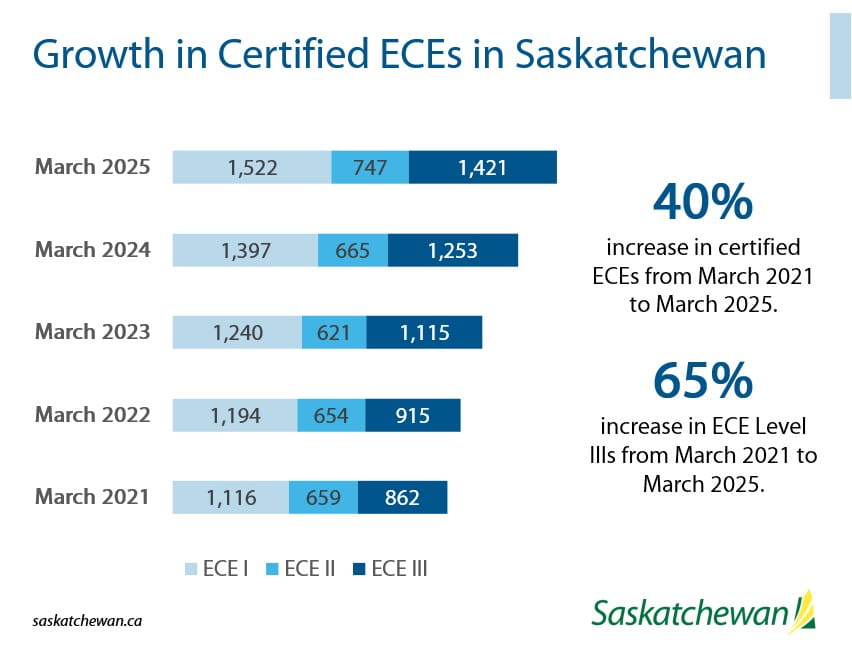
1. Growth in the Number of Certified ECEs
The following initiatives have been supporting the growth of the ECE workforce. Between March 2021 and March 2025, there was a 40 per cent increase in the number of certified ECEs working in child care centres. This includes a 65 per cent increase in the number of ECE IIIs. This growth in the number of certified staff has been supporting the expansion of quality programs in child care spaces across the province.
2. ECE Wage Enhancements
ECE Wage Enhancements provide a wage top-up of up to $8.85 per hour for certified ECEs to help recruit and retain trained workers. ECE Wage Enhancements were first introduced in September 2021. The grant provides funding to child care facilities based on the hours worked to top-up the wages of certified ECEs working in regulated child care centres and assistants in group family child care homes. As of September 2024, the enhancement is supporting certified ECEs with the following amounts:
- Up to $5.85 per hour for ECE Level I.
- Up to $7.35 per hour for ECE Level II.
- Up to $8.85 per hour for ECE Level III.
See Section 83.4 of The Child Care Licensee’s Manual for more information about the ECE Wage Enhancement.
3. Early Learning and Child Care (ELCC) Workforce Enhancement Grants
ELCC Workforce Enhancement Grants are provided to regulated centres and group homes for employer-led recruitment and retention initiatives. Employers have the flexibility to determine how to best meet the unique workforce challenges they experience and can use funding for bonuses for long-term staff, investments into health benefits or pensions, and bonuses for staff when they complete an ECE certification level.
See Section 83.5 of The Child Care Licensee’s Manual for more information about the ELCC Workforce Enhancement Grant.
4. Tuition-free Post-Secondary ECE Training, Professional Development and Financial Supports
Since 2021, the province has been making investments to support the skills and capacity of ECEs through investments into tuition-free post-secondary ECE training, professional development and financial supports. These investments include:
- Tuition-free training and professional development opportunities.
- Supports while ECEs study.
- Reimbursement of tuition expenses.
- Dual credit opportunities for high school students.
- Bursaries.
5. Baseline Quality Assessment with the Saskatchewan Quality Tool
The Ministry of Education collaborated with Dr. Richard Fiene and the National Association of Regulation Administration (NARA) to develop a quality assessment tool called Saskatchewan's Early Learning and Child Care Quality Key Indicator Instrument (SK Quality Tool). This tool is designed to evaluate the quality of child care centres in Saskatchewan. The 10 quality key indicators that make up the tool were selected from studies conducted by Dr. Fiene over the past 40 years.
To ensure consistent results across all age groups, centre quality was evaluated using both the SK Quality Tool and the well-known Early Childhood Environment Rating Scale-3 (ECERS-3) tool and Infant/Toddler Environment Rating Scale (ITERS). Saskatchewan began implementing the tool in all child care centres in March 2024 and assessment of all centres is now complete.
Following data collection, the ministry is conducting in-depth analysis to determine trends and correlations to support development of professional learning opportunities and resource for quality improvement.
Boards are encouraged to add progress on their centre’s quality action plan as a recurring item on the agendas of their regular board meetings. Early Learning and Child Care Consultants will follow up on progress regarding the action plan when they attend board meetings and during monitoring visits.
Progress on the action plan will be addressed and documented during the annual licensing process. The Child Care Regulations, 2015, section 14, Philosophy and Program, requires that a licensee must plan and implement a daily program of activities that is developmentally appropriate for the ages of the children attending the facility and for each child.
6. Saskatchewan Early Childhood Association (SECA) Recruitment and Retention Initiatives
Saskatchewan has provided SECA, the province’s largest early childhood educator organization, grant funding to support recruitment efforts and leadership-focused professional development.
This work is focused on connecting with prospective ECEs at career and education fairs, and social media outreach highlighting the benefits of the ECE profession, supporting the sector to hire new staff. To support leaders in the sector, SECA contracted with a third party to offer the Activated Leadership and Leading as a Coach professional development series. These opportunities focus on problem solving, managing conflict and creating positive, functioning work environments through large group, small group and individual coaching and facilitation.