
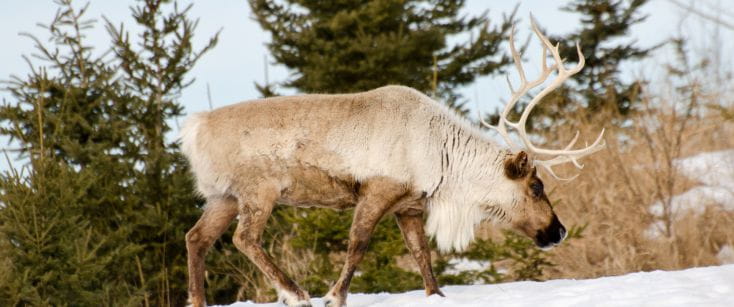
Woodland caribou are integral to boreal forests in Saskatchewan and are a culturally significant species to Indigenous people.
Caribou is a wide-ranging species belonging to the deer family. In Canada, there are three sub-species of caribou – woodland, barren-ground, and Peary caribou. The boreal woodland caribou population is the most widely distributed in Canada and is found in northern Saskatchewan year-round. Barren-ground caribou spend the winter in northern portions of the province, but historically, migrated as far south as Cree Lake and the Churchill River.
Woodland Caribou Biology and Habitat
Woodland caribou have a rounded, crescent-shaped hoof print. Both males and females have antlers that grow and fall off seasonally. In winter, caribou dig through the snow to access lichen, leaving behind pits called “craters”. Woodland caribou require large areas of mature to old-growth coniferous forest and peatlands (also known as muskeg). Peatlands offers areas to escape from predators, especially during calving. Jack pine forests rich in lichen provide foraging areas. Caribou naturally live at low densities to avoid predators (primarily wolves and bears) and find enough food.
Read the Woodland Caribou Fact Sheet
Species at Risk and Conservation
In 2003, boreal woodland caribou were listed as threatened under the federal Species at Risk Act. The federal government created a national recovery strategy in 2012. Amendments were made to the recovery strategy in 2020 to incorporate research from Saskatchewan's boreal shield.
Disturbances in older conifer forests and peatlands – including industrial activity, roads, forest harvest and wildfire – may change the amount and location of available habitat for caribou. Roads, trails and seismic lines can give people and predators access to caribou. This can disrupt feeding and resting areas and make caribou more vulnerable to predators. As caribou have only one calf per year, increased disturbance and predation can lead to a significant decline in their population.
In 2013, the province completed the Conservation Strategy for Boreal Woodland Caribou in Saskatchewan. Through the range planning process, we are moving forward with a made-in-Saskatchewan solution for caribou habitat management and woodland caribou population sustainability. The province uses a balanced, landscape-level approach to caribou range planning with benefits for other boreal species and overall landscape health.
Saskatchewan has been developing range plans to address habitat management for woodland caribou. As of 2025, range plans for the SK2 Central and SK2 West caribou administrative units have been developed and approved. The draft SK2 East caribou range plan is under review. The SK1 range planning process began with the first planning table in December 2023. The range plans outline strategies for managing woodland caribou habitat while acknowledging Traditional land use and allowing for continued economic activity in northern Saskatchewan.