
Through Prairie Resilience, Saskatchewan has adopted a variety of policies and programs to address climate change.
It’s challenging work – but we’re making progress.
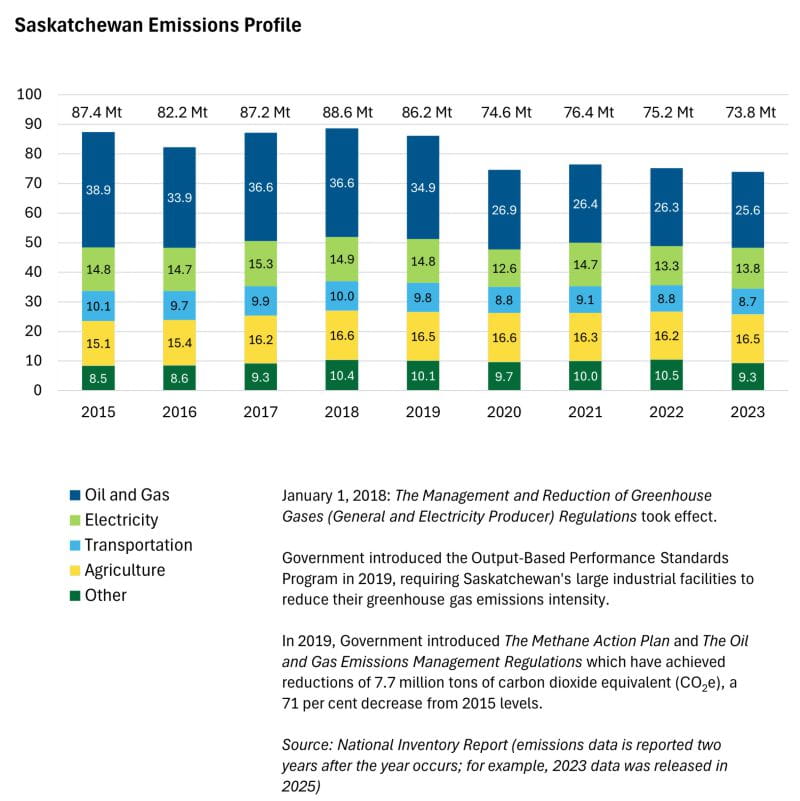
According to Canada’s most recent National Inventory Report (2025), Saskatchewan’s total emissions were 73.9 million tonnes in 2023, a 16.6 per cent reduction (14.7 Mt) from 2018, when Saskatchewan’s emissions peaked at 88.6 million tonnes. Of the 14.7 Mt in emission reductions achieved, 50 per cent (7.3 Mt) can be attributed to Saskatchewan’s Methane Action Plan, which has significantly decreased venting, flaring and fugitive emissions within the oil and gas sector.
Emissions by Sector
Emissions Intensity in the Province
Through Prairie Resilience, the Government of Saskatchewan is making meaningful reductions in GHG emissions while protecting our economy and strengthening our resilience to a changing climate. Climate change cannot be effectively addressed without the resources provided by a strong and vibrant economy. That balance is achieved by focusing on reductions in GHG emissions intensity – the amount of GHG emissions generated per unit of production.
Saskatchewan's GHG emissions intensity peaked in 1995 at 1,416 tonnes of CO2e per million dollars. It has been trending downward ever since, with emissions intensity declining 30 per cent since 2005.