
Commercial Vehicle Overweight and Over-Dimensional Permits
If you are moving a commercial vehicle or load that’s bigger or heavier than allowed, you will likely need a permit before travelling on Saskatchewan highways. This page explains when a permit is required, what types are available and how to apply.
Disclaimer
The Minister of Highways may, after consulting with the permit holder and without cost or liability, amend, suspend or cancel a permit, or refuse to issue permits, under Sections 47 to 50 of The Highways and Transportation Act, 1997. If permit conditions are not followed, future permits may be cancelled or refused.
1. When You Need a Permit
You will need a permit if your vehicle or load doesn’t meet the limits set out in The Vehicle Weights and Dimensions Regulations, 2010. Permits are issued under Section 36 of The Highways and Transportation Act, 1997.
Most permits are issued when:
- The vehicle or load can’t meet legal size or weight limits; and/or;
- The load is non‑divisible, meaning it can’t be broken into smaller parts.
2. Types of Permits Available
Single Trip Permit
A single trip permit is for a one‑time move on a specific route.
Most single trip permits give you up to two weeks to complete the move.
Annual Permit
An annual permit lets you travel on multiple highways throughout the province.
These permits aren’t available if the vehicle or load exceeds certain size or weight limits.
Special Permit
A special permit may be issued when:
- A vehicle doesn’t meet regulations; and/or
- There isn’t a current permitting policy for the move.
Special permits are issued directly by the Ministry of Highways and usually take longer to review.
3. How to Apply for a Permit
You can apply through the Saskatchewan Government Insurance (SGI) Permit Office.
The Permit Office is open seven days a week, from 6 a.m. to 10 p.m., including most statutory holidays. It is closed on Christmas Day, Boxing Day and New Year’s Day.
Contact the Permit Office
- Phone: 306‑775‑6969 (Regina and outside Saskatchewan)
- Toll‑free: 1‑800‑667‑7575 (within Saskatchewan)
- Fax: 306‑775‑6909
- Email: sgipermitoffice@sgi.sk.ca
4. Information You'll Need to Apply
You will need to provide accurate details about your vehicle, load and route. Having this information ready helps avoid delays.
Applicant and Vehicle Information
- Your name
- Company name
- Phone number
- Email address
- Date(s) of travel
- Permit type (annual or single trip)
- Vehicle registration
- Pro Rate / IFTA (SGI)
- Plate number
- What you’re hauling
- Vehicle configuration
- Tire size
Dimensions
Overall dimensions
- Overall width
- Overall length
- Overall height
- Base width (for moving buildings only)
Vehicle and trailer details
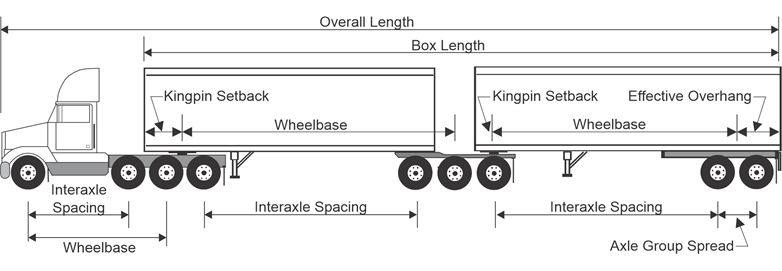
- Truck length
- Truck tractor wheelbase
- Hitch offset
- Trailer length or box length
- Trailer wheelbase
- King pin setback or effective front overhang
- Rear overhang
- Effective overhang
- Interaxle spacing
- Axle group spreads
Weights
- Weight per axle group
- Registered gross vehicle weight (out‑of‑province vehicles)
- Actual gross vehicle weight
Route Information
- Starting and ending locations
- Legal land description (for example: 12‑15‑24‑W2);
- GPS coordinates (for example: 50.265962, ‑102.65933); or
- Border location (for example: MB border Hwy1)
- Roads used between the start and end points
5. How Long it Takes to Get a Permit
For most non‑complicated moves, the goal is one business day. If all required information is provided and no extra review is needed, many permits are issued within an hour.
Some moves take longer.
Moving a Building
- Reviews can take up to two weeks
Massive Moves
- Reviews can take months or longer
- The moving company must submit a Transportation Management Plan (TMP)
Long Combination Vehicle (LCV) Program
- Entry into the program can take up to one month
- Once approved, annual permits are issued by the SGI Permit Office
6. Other Things to Know Before You Apply
- Rural municipality approval is required if your route includes municipal roads and the vehicle exceeds legal secondary weights.
- City permits are required for any travel on city streets.
- SaskPower and SaskTel approval is required if the overall load height is more than 5.18 metres.
- If the height exceeds 6.0 metres, copies of these approvals must be submitted with your application.
- If your route includes railway crossings and the vehicle is wider than the crossing clearance, you must notify the rail companies and provide proof of notification.
- Only rail companies can move railway crossing signs.
- Line diagrams, photos and scale tickets may be requested.
7. If You Need Signs, Lights, Escorts
Most permits require warning signs, lights and escort vehicles. What’s needed depends on:
- The size of the load, and
- The time of day you’re traveling.
For more details:
- See Weights and Dimensions Administration Manual – Policy 901.
- For escort vehicles, see Policy 801.
8. Permits to Move Farm Equipment
A permit is required to move farm equipment when:
- You’re travelling on a high‑traffic highway, or
- You’re travelling after sunset.
Farm‑plated trucks and trailers are not considered farm equipment and must follow standard permit rules.
9. If Your Load Exceeds Divisible Weight and Dimension Limits
The ministry offers Transportation Partnership Programs. These programs allow some divisible loads to move at higher weights or dimensions through a signed agreement with the ministry.