
By Dwayne Summach, PAg, Livestock and Feed Extension Specialist, Outlook
February 2026
Buying bulls is an opportunity to influence a herd’s future genetic potential. Using all available tools assists in the efficient deployment of limited resources – your cash and your time. Buying the next bull often starts with flipping through sale catalogues – either hard copy or online. Pictures of possible future herd sires may stir the desire to attend a sale and partake in the bidding but reviewing your herd goals and data, both on the farm and in the catalogues, can assist in narrowing the focus of your search to a select group of candidates.
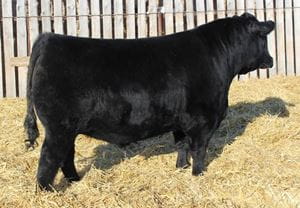
Spending time reviewing your own data on how your herd currently performs is the first step in selecting your next bull. Think about reproductive efficiency, unassisted calving, mature cow size, milking ability, foot and udder conformation, weaning weight, feed efficiency and growth rate. Be honest with yourself when asking “what needs attention?” Once you have identified the item to focus on, consider if this trait have low, medium or high heritability? Also consider if there are management decisions that are influencing how the genetic potential is being expressed.
Upon identifying the characteristic(s) which you are determined to improve, the published Expected Progeny Differences (EPDs) are a starting point to help identify potential candidates for purchase. If unassisted calving in your mature cow herd is one of your goals, you are likely to select a bull that will throw average to slightly lower birth weight calves. Alternately, if higher weaning weights is the identified goal, you may opt for bulls with average to slightly higher birth weights that produce substantially higher weaning weights.
EPDs are useful for comparing bulls within a single breed but you do need to understand how the system works. For a long time, I thought a smaller Calving Ease number meant the bull would produce smaller calves. That interpretation was backwards. A larger Calving Ease number actually indicates easier calving. Making Sense of Expected Progeny Differences from the Beef Cattle Research Council is a handy guide to help keep the various EPDs straight.
Using EPDs can help you limit the pool of bulls you actually need to look at prior to purchasing. Regardless of how good the numbers are, if something is off during your visual assessment, you should probably select another animal to be your next herd sire.
For more information, check out the Beef Cattle Research Council's website, contact your local livestock and feed extension specialist or contact the Agriculture Knowledge Centre at 1‑866‑457‑2377.