
The Truth and Reconciliation Commission of Canada (TRC) was officially established in 2008, with the mandate to inform all Canadians of what happened in residential schools. The TRC documented the truth of survivors, their families, communities and anyone personally affected by the residential school experience.
On June 2, 2015, the TRC released a summary report on the experiences and legacy of Canada’s residential schools. The report contained 94 Calls to Action, and the final report was released on December 15 of that year.
It has been a decade since the release of the TRC’s final report, and the Government of Saskatchewan remains committed to advancing truth and reconciliation in the province, responding to 30 of 34 Calls to Action directed at provincial governments, as well as 16 additional Calls that are not directed at the province but align with provincial priorities.
In December 2025, the Government of Saskatchewan released a document to mark the 10-year anniversary of the TRC’s final report and to demonstrate the government’s work to support reconciliation. The themes of the 94 Calls to Action were used to structure the document, titled “Dayagen Togada Mani: 10 Years of Action Supporting Truth and Reconciliation in Saskatchewan.” The document does not include every action undertaken by Saskatchewan’s ministries, agencies and Crowns, but provides a high-level overview of efforts across government.
Dayagen Togada Mani is a Nakota phrase that means “moving ahead in a good way”. This title was written in consultation with Nakota language speakers and Elders, who suggested a focus on the future. While this document provides a selection of government actions over the past decade, it is also intended to guide acts of truth and reconciliation into the future.
Highlights from the Report
There are many exciting and innovative programs, policies and projects spotlighted within “Dayagen Togada Mani: 10 Years of Action Supporting Truth and Reconciliation in Saskatchewan.”
Following Their Voices Calls to Action #7, 62, 63
Launched in 2015, Following Their Voices is a made-in-Saskatchewan education initiative designed to improve learning outcomes for First Nation, Métis and Inuit students by fostering culturally responsive, student-centred learning environments. The initiative was developed through extensive research and engagement with Indigenous students, families, educators and school administrators, alongside guidance from Elders and Knowledge Keepers representing all Indigenous language groups in the province.
Following Their Voices schools are demonstrating success. For example, in Following Their Voices schools, the number of Indigenous students who graduate within three years is up from 32 per cent in 2015 to 45 per cent in 2025. This is 220 more Indigenous graduates than a decade ago.
Read “Dayagen Togada Mani: 10 Years of Action Supporting Truth and Reconciliation in Saskatchewan” to find out more.
The Saskatchewan Health Authority Commits to Truth and Reconciliation Calls to Action #18, 22, 23, 66, 92
The Saskatchewan Health Authority (SHA) made a formal commitment to the TRC Calls to Action during a public signing event in 2019 and then formed a working group to monitor the progress of goals that align with that commitment. This includes enhancing cultural safety and anti-racism training for staff and physicians, increasing recruitment and retention initiatives for Indigenous staff, and incorporating traditional healing spaces and culturally responsive models of care into the builds of several major programs in partnership with First Nation and Métis organizations.
The SHA has also established the Traditional Knowledge Keepers Advisory Council to provide ongoing guidance and recommendations to the SHA on implementing system change to better meet the needs of First Nation and Métis individuals, families and communities, and has developed a Systemic and Indigenous-specific Anti-racism Framework that will be rolled out to staff.
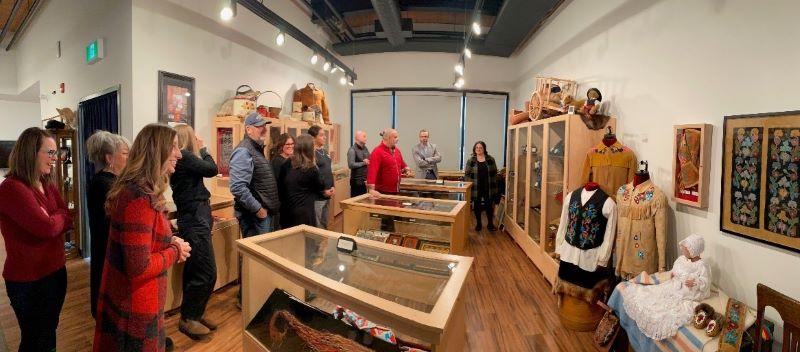
The Respectful Terminology Project Call to Action #57, 70
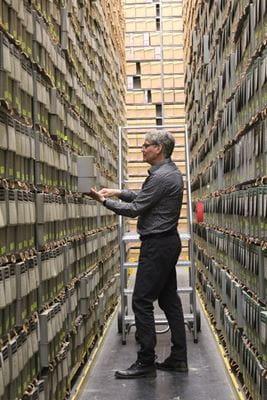
In the Respectful Terminology Project, archivists at the Provincial Archives of Saskatchewan work to identify and update outdated, offensive, and hateful language found in the Archives catalogue. This language can be racist, sexist, ableist, or other forms of discrimination that are illustrative of the records’ time of origin but are now known to be harmful. The original language is not deleted; rather, it is maintained in a separate field to provide context of the period in which the record was created. This project was completed in September 2025 with 1,970 catalogue descriptions being addressed.
Image right: Archivist Donald Johnson browses records at the Provincial Archives of Saskatchewan. Johnson was a member of the steering committee that drafted the Reconciliation Framework for Canadian Archives.