Google Translate Disclaimer

A number of pages on the Government of Saskatchewan's website have been professionally translated in French. These translations are identified by a yellow box in the right or left rail that resembles the link below. The home page for French-language content on this site can be found at:

Renseignements en Français

Where an official translation is not available, Google™ Translate can be used. Google™ Translate is a free online language translation service that can translate text and web pages into different languages. Translations are made available to increase access to Government of Saskatchewan content for populations whose first language is not English.

Software-based translations do not approach the fluency of a native speaker or possess the skill of a professional translator. The translation should not be considered exact, and may include incorrect or offensive language. The Government of Saskatchewan does not warrant the accuracy, reliability or timeliness of any information translated by this system. Some files or items cannot be translated, including graphs, photos and other file formats such as portable document formats (PDFs).

Any person or entities that rely on information obtained from the system does so at his or her own risk. Government of Saskatchewan is not responsible for any damage or issues that may possibly result from using translated website content. If you have any questions about Google™ Translate, please visit: Google™ Translate FAQs.

Initial Outlook Shows Average Spring Runoff For Most Of Saskatchewan

Released on February 7, 2020

Today, the Water Security Agency (WSA) released the preliminary spring runoff outlook for 2020.

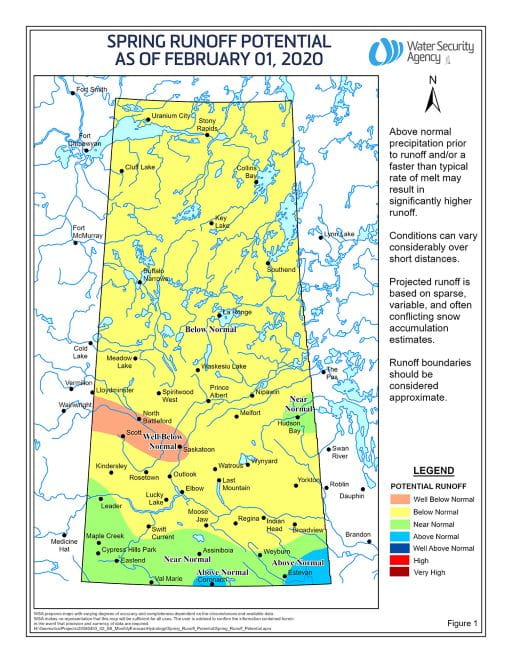
Although well below normal snowfall accumulations have occurred to date over the southern portion of the province, near normal snowmelt runoff is expected over these areas because of an extremely wet fall.
Spring Runoff

Throughout the fall, most of southern Saskatchewan received precipitation well above normal, with the wettest areas being around Swift Current and the Souris River Basin. While wet conditions at freeze-up increase the runoff potential during the spring melt, it does not guarantee that a flood will occur.

In central and northern Saskatchewan, below normal spring runoff is expected across most areas because of near normal moisture at freeze-up, combined with below normal winter precipitation. Only some northern areas, particularly around Cluff Lake, have received near normal winter precipitation to date.

Last summer saw near to above normal rainfall, which alleviated the dry conditions experienced throughout most of the grain belt last spring. The only areas where drier than normal conditions still existed at freeze-up were around Kindersley, between Saskatoon and Prince Albert, and a small area northeast of Yorkton extending to the Manitoba border.

While conditions over much of the south were wetter than normal last fall, conditions were not as wet as the falls of 2010 and 2016.

Precipitation amounts are predicted to be near normal across the province for February, March, and April. However, the spring runoff outlook could change as there is potentially another 8-10 weeks of winter remaining. The first spring runoff forecast will be issued early in March.

-30-

For more information, contact:

Patrick Boyle
Water Security Agency
Moose Jaw
Phone: 306-694-8914
Email: Patrick.Boyle@wsask.ca
Cell: 306-631-6997


We need your feedback to improve saskatchewan.ca. Help us improve