
Graham Parsons, MSc, PAg, Pollinator Biosecurity Specialist, Prince Albert
Pollinators are often treated as a “nice-to-have” in annual cropping systems, yet they are essential partners in successful forage seed production and a good management practice for whole-farm resilience.
Producers can improve forage stand establishment and seed yield through proper management while meeting goals for biodiversity and landscape health.
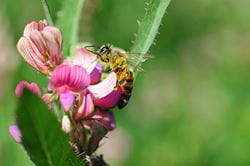
Many forages, especially alfalfa, red clover, sainfoin, cicer milkvetch and other legumes, depend on or significantly benefit from insect pollination to set seed. While some crops self or wind pollinate, forage seed production typically requires bees (honeybees, bumble bees, leafcutter bees or wild bees) to move pollen efficiently among flowers.
In canola, for example, increased insect pollination can increase yield by around 20 per cent, and mustard and sunflower show similar gains. For seed production in red clover, alfalfa, borage, sainfoin and several herbs, adequate insect pollination is non-negotiable. Without it, seed set and marketable yield can drop dramatically. Planning for pollinators is therefore a prudent agronomic investment, rather than an optional add-on.
The Resilient Agricultural Landscapes Program, funded through the Sustainable Canadian Agricultural Partnership, aims to enhance the environmental resilience of agricultural landscapes by providing funding for beneficial management practices. The program includes the inclusion of pollinator-supportive species for forages.
Under the program’s Seeding Forage Best Management Practice – Tame Forage stream, producers can include pollinator friendly species in tame forage mixes or in establishing adjacent habitat to support pollinators throughout the season. Including pollinator-friendly species aligns with program objectives regarding improving soil health, biodiversity and building more resilient landscapes.
This program requires an Agri- Environmental Risk Assessment for eligibility. Referencing and reviewing the program criteria in the Sustainable Canadian Agricultural Partnership will help ensure your mix, seed sources, timing and field selection meet current eligibility and documentation requirements if you are planning to complete a seeding forage project under the program.
Planting forages for pollinators can include fundamental planning about location and timing. Where agronomically suitable, include multiflowering legumes (e.g. red clover, alsike clover, sainfoin) and manage for staggered blooming so nectar and pollen are available from spring through late summer. Even when the target crop is not insect-dependent, companion or perimeter plantings can sustain pollinators before and after the seed crop blooms, supporting stronger bee populations when you need them most.
Place forage seed fields near high-quality habitat – wetland edges, prairie remnants, willows, shelterbelts, uncultivated corners or ditches – to help build existing habitat and maximize the benefit of these landscape features.
A mosaic of small patches (even five metre squares) within or adjacent to fields can support ground and stem nesting species. Aim to keep nesting sites within approximately 200 metres of forage bloom for smaller pollinators. Poorly yielding, saline or erosion-prone areas make excellent habitat locations that also reduce input costs.
Use economic thresholds and choose the least harmful pesticide options for beneficial insects when control of pest insects is necessary. Time pesticide applications for night, dusk or dawn to avoid peak bee foraging, and avoid over spraying on blooming field margins and wetlands. Checking FieldWatch® for registered apiaries can prevent conflicts with beekeepers and other spray-sensitive areas. These preventive steps help protect managed honey/leafcutter bees and bolster wild pollinators that spill into seed fields.
For forage seed crops with higher insect dependence, contracting local honey bee or leafcutter beekeepers can improve seed yield. Many pollinated crops require about two hives per acre (crop-specific recommendations vary). Provide good wind shelter and a nearby water source to keep colonies productive and onsite. Pairing managed bees with nearby habitat for wild pollinators often yields the best results.
Pollinator-friendly forage systems do more than set seed. They reduce erosion, improve water infiltration, protect wetlands, store carbon, and maintain biodiversity – all outcomes that align with resilient farm management and the program’s objectives.
In short, what’s good for pollinators is good for forage seed production and the farm. Pollinators result in better seed set, stronger stands and a more robust agroecosystem ready for weather and market variability.